Loss of Africa’s Larger Mammals Has Reduced Essential Ecosystem Functions

By Dr Daniel Stiles
A recent study from Oxford University has revealed a severe loss of ‘wildlife power’ across Africa — the ecological energy that drives essential ecosystem functions such as nutrient cycling, pollination, and seed dispersal.
This study provides hard data to support the UK’s Global Biodiversity Loss, Ecosystem Collapse, and National Security report that Patrol described in February 2026.
The researchers adopted an ecosystem energetics approach as a useful method of translating animal species composition into a set of ecosystem functions.
Drawing on new datasets that estimate biodiversity intactness and species population densities, they quantified historical changes in energy flows through mammal and bird-mediated ecosystem functions across sub-Saharan Africa.
In total, trophic energy flows have decreased by more than one-third.
The researchers calculated energy flows for the 1,088 mammal and 1,955 bird species for which data were available, comprising 98 per cent of total African species, excluding seabirds.
The analysis combined six major ecological datasets, including a new Biodiversity Intactness Index for Africa built with local expert knowledge.
This energy-based view reveals not only how much biodiversity has been lost, but how that loss affects the very functioning of nature.
Because large mammals have suffered the greatest declines, smaller species such as rodents and songbirds now dominate Africa's remaining energy flow.
As a result, ecosystems are increasingly powered by small animals.
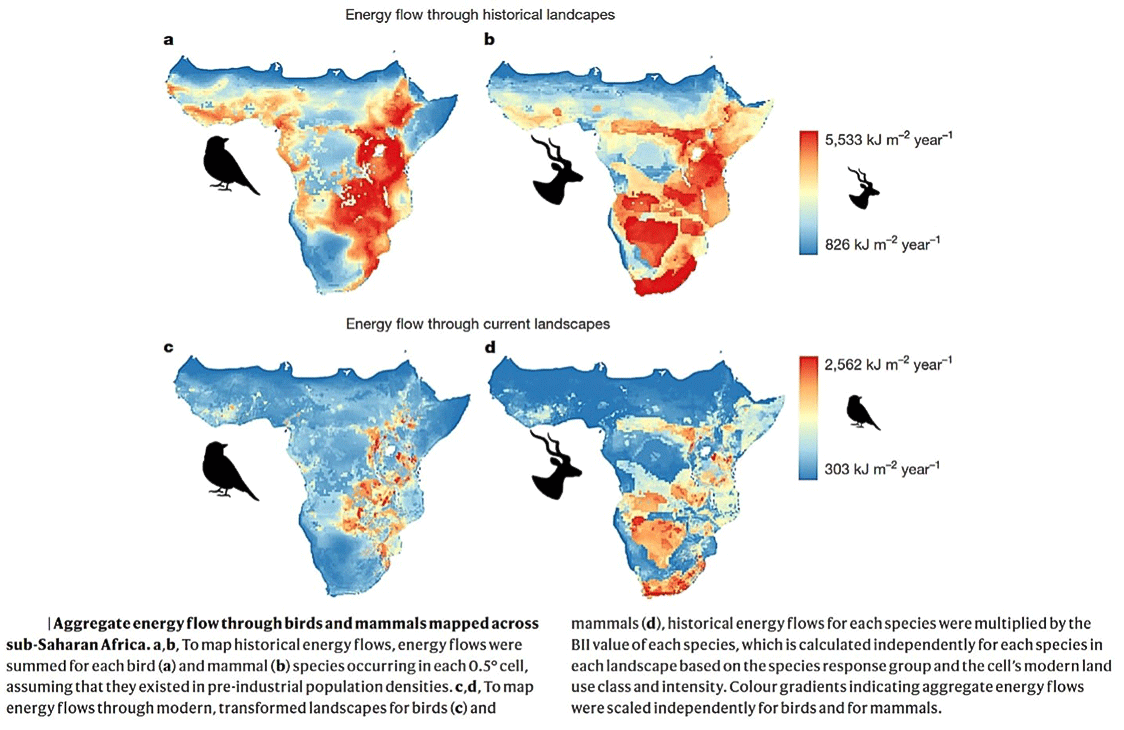
One can see that the historical landscape contained a much higher energy flow generated by wildlife than the current one.
Unfortunately, the publication did not indicate the period of the ‘historical landscape’, whether it was 10, 20, 50 years ago, or…?
Animals weighing more than 65 kilograms now account for just 7 per cent of energy use, down from 16 per cent historically.
Previously, elephants were by far the biggest drivers of ecological energy in Africa.
They once made up about 16 per cent of total bird and mammal biomass and 10 per cent of total energy flow — more than any other species.
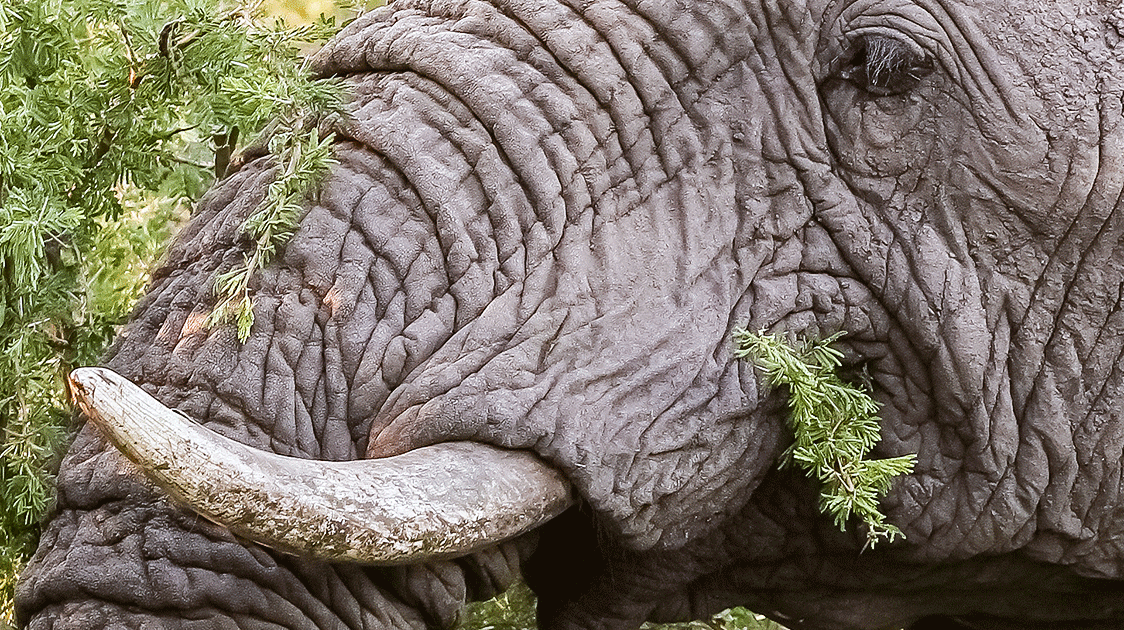
Through their feeding, movement, and dung dispersal, elephants shaped landscapes and influenced how much carbon ecosystems could store.
Ian Redmond, elephant expert, often refers to them as “gardeners of the forest”. Although elephants remain ecologically crucial, their impact has been greatly reduced.
Other applications of energetics
Another application of energetics approaches to studying biodiversity loss is to advance global biodiversity assessments.
In particular, ecosystem energetics can provide metrics to track changes in animal-mediated ecosystem functions.
The novel scale of this study, which expands previous plot-based energetics analyses to an area of more than 20 million km2, enables the integration of these metrics into global assessments of biodiversity loss.
For example, energy-based metrics of ecosystem change can complement the richness and abundance-based metrics that currently underpin assessments by the Intergovernmental Science Policy Platform on Biodiversity and Ecosystem Services.
Energetics can also improve efforts to integrate biodiversity loss into the planetary boundaries framework.
It is contested whether a planetary boundary for biodiversity is meaningful because of the heterogeneous, local, and spatially disconnected nature of ecological functions.
However, the energetics approach that the researchers have outlined introduces a method that enables biodiversity and its intactness to be related to a suite of ecosystem functions, whether at local, regional, or planetary scales.
Conclusions
This analysis demonstrates how an energetics approach can quantify the decline and recovery of ecological functions mediated by birds and mammals. It fills an important gap.
Although it is increasingly clear that animals shape landscapes and the Earth system in important ways, their functions have been inadequately quantified over large spatial scales and have not been integrated into Earth system models.
The energetics approach presented in this study provides at least three advantages over approaches that consider species richness or abundances alone.
First, instead of weighting species equally, an energetics approach weights species based on food consumption, an ecologically meaningful indicator of a species’ ecological importance within a landscape.
Identifying each species’ trophic importance can help reveal where keystone species contribute disproportionately to various ecosystem functions, and how the importance of key species varies across biomes, land uses, and functions.
Second, energetics provides a mechanism for bringing animal activity into the quantitative, mechanistic framework of biosphere modeling and Earth system science, which, to date, has been governed by the ecological functions provided by vegetation and largely ignores those provided by animals.
Using energetics, changes in animal populations can be related to Earth system processes by estimating how animals affect vegetation structure, both directly through grazing and browsing and indirectly through seed and nutrient dispersal, vegetation loss from herbivorous insects, and soil disturbance.

Third, energy can be used to quantitatively compare how changes in species composition alter the strength of ecosystem function across land uses and biomes.
The authors believe that the sub-continental-scale analysis presented in this study is an important step forward in the challenge of relating animal biological richness and intactness to large-scale ecological and planetary function.
Without reversing the current trend of biodiversity loss, and thus of energy loss, ecosystem functions will continue their trajectory towards total collapse.
Dr Stiles started in anthropology and archaeology, researching past and present natural resource use among hunter-gatherers and pastoralists, and later moved to the UN system, working on desertification control. In 1999, he began investigating wildlife trade, producing reports and publications for UN agencies, the IUCN, TRAFFIC, and various NGOs.