Aerial Support
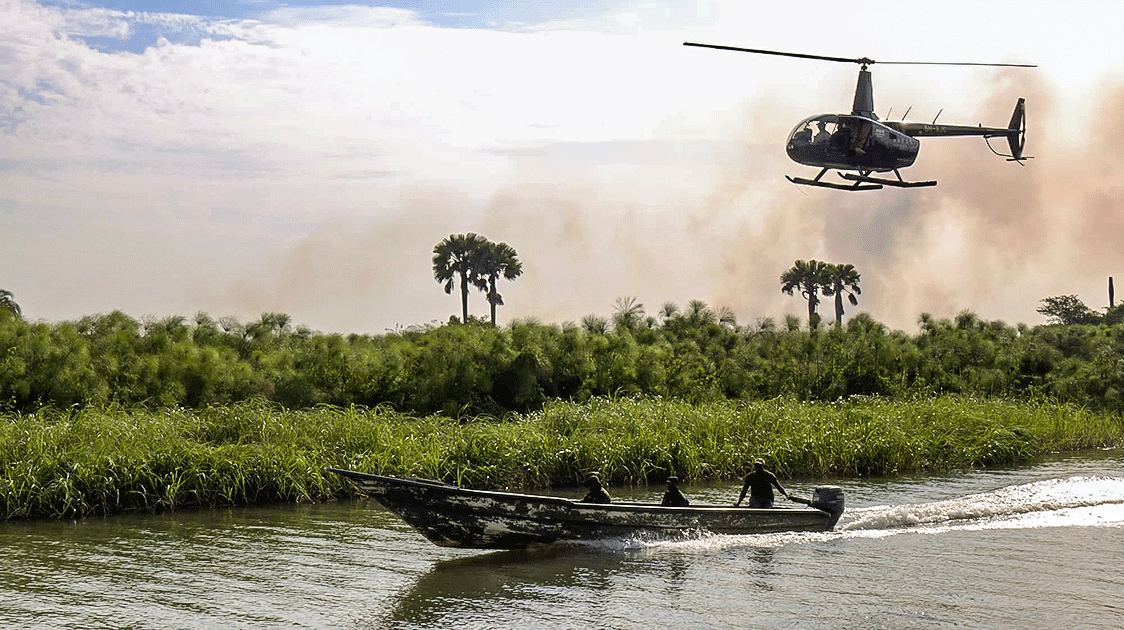
Aerial support covers ground that no foot, vehicle or boat patrol can. On a 5,000 km² reserve, even a fully resourced ranger force cannot maintain an effective presence across the full area.
A single light aircraft flying a few hours a week extends the range of what the ground patrols can see. The aircraft does not catch poachers. The ground team does. The aircraft tells the ground team where to go.
Aerial work in African anti-poaching comes in three forms: microlight and light-sport aircraft (the dominant platform), helicopters (used selectively because of cost), and drones (now standard on better-funded operations).
Microlights and light aircraft: the Bat Hawk
The standard fixed-wing anti-poaching aircraft across southern and eastern Africa is the Bat Hawk, a South African-built light-sport aircraft from Micro Aviation.
The acquisition cost is around USD 30,000 at current rates, and the operating cost is approximately R400 per hour, which is a fraction of helicopter costs. The aircraft has high cockpit visibility, short take-off and landing distances, and is powered by a 100-125 hp engine. Since 2014, around 150 units have been built.
Most have gone to wildlife conservation users. DefenceWeb covered the platform in detail.
Operators include SANParks, parks in Mozambique and Tanzania, private game reserve owners, wildlife trusts, the Botswana Defence Force, the Botswana Police Service and Botswana’s Department of Wildlife and National Parks.
The Bat Hawk is, in practical terms, the workhorse of African anti-poaching aviation.
LUWIRE in Niassa, Mozambique, runs Bat Hawks for surveillance over its million-acre reserve.
The aircraft significantly reduces travel time compared to ground vehicles and gives excellent visibility for reserve monitoring. Patrol covered the LUWIRE aviation picture in Patrolling Versus Intelligence.
Helicopters
Helicopters carry capabilities the fixed-wing platforms do not: hover, vertical insertion, casualty evacuation, and the ability to land in confined areas.
Operating costs are substantially higher than those of light aircraft, which is why most reserves use helicopters selectively rather than for routine patrol.
The Alistair Group operates a helicopter support programme over the Moyowosi-Kigosi Game Reserve and Malagarasi-Muyovozi Ramsar Site in western Tanzania.
Patrol covered this in World Wetlands Day 2026. Aerial reconnaissance is the most reliable method for detecting fish camps and snare lines in dense vegetation across that landscape.
In rhino-protection operations on the Kruger boundary and across South Africa, helicopters carry veterinary teams for dehorning operations and casualty evacuation.
They also enable rapid-response interventions when ground intelligence flags a probable incursion.
Drones
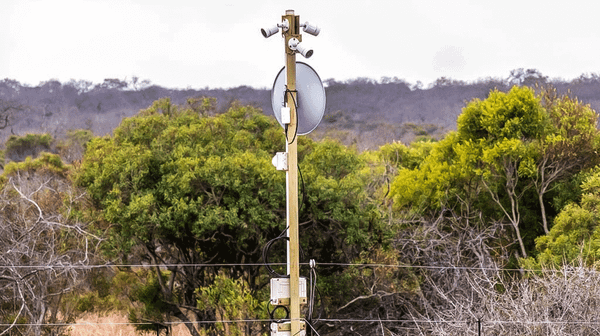
Drones extend a unit's line of sight. They do not extend what a unit can do. A thermal camera picks up a heat signature in thick bush at night, but a ranger team still has to walk in, identify the target and make the call.
Battery life is the dominant constraint. Most multirotor platforms used in anti-poaching work give 30 to 45 minutes of flight time per charge. Fixed-wing drones extend that envelope but trade vertical manoeuvring.
Weather, wind, dust and the cost of replacement airframes all constrain operations. Most reserves running drones also run dogs, foot patrols and an informer network. The drone is one input into the ops room. The operation runs on the people.
Kwandwe Game Reserve in the Eastern Cape runs an integrated system that combines AI-equipped rhino ankle collars with drone deployment.
When a rhino’s movement pattern deviates from its learned baseline, a drone is automatically dispatched and feeds live thermal imagery back to the ops room.
The wider South African surveillance picture is covered in Wired for Wildlife, Watched by Default.
What aerial support does not do
Aerial assets are observation platforms, not arrest tools. The aircraft sees the target, radios the ground team, and the ground team makes contact.
This means an aerial programme is only as good as the ground team it supports. A reserve with strong aerial coverage and weak ground response gets data, not arrests.
Aerial work is also weather-dependent and daylight-dependent in most operations. Night thermal flights happen, but are expensive and require pilots trained for them. The standard operational pattern is dawn- and dusk-patrols, when wildlife is most active and heat signatures are most visible against cooler ambient temperatures.