17 Permits to sell a Springbok and one to sell a Sheep?

By Prof Brian Child
Key Takeaways
- Wild resources are taxed and regulated in ways no farmer would tolerate for livestock. A South African farmer needs 17 permits to sell a springbok and one to sell a sheep. That asymmetry shifts land-use decisions against wildlife.
- Wildlife is priceless to society but worthless to the people living on the land. This gap between the economic and financial prices is where conservation fails, because landholders make decisions based on the financial price.
- The idea that markets are too crude to govern wild resources is not supported by the evidence. Privately owned crops, cattle, and forestry have generally fared far better than wild resources kept out of the market under public protection.
- Private property rights work best paired with local collective self-regulation, not state policing. Catchment-level groups of resident landholders internalize externalities in ways central regulators cannot.
- Family and community ownership beats absentee corporate or state control. The case is not for extractive capitalism but for community property rights with social equity, where the people living with wildlife are the rightful beneficiaries.
The problem of differential taxation and regulation
The negative effects of differential taxation and regulation on wild resources are seldom recognized. Differential taxation is where, for example, a proportion of the income from wild resources is extracted by administrators, such as national agencies or district councils, when this is not done for domestic species.
“Taxing” crops or livestock by retaining 50%, 80%, or even 100% of the sales price would cause a public outcry, and even riots, yet it is common practice for wild resources.
Similarly, governments and NGOs often insist that communities use wildlife income to provide social services and infrastructure, yet the dollars from domestic species go directly into people's pockets.
They forget that this undercuts the price of wild products compared to domestic ones in the eyes of the people living on the land, and making the land use decisions.
Moreover, any situation in which some resources are taxed while others are not causes economic distortions and misallocation of resources.
The same logic applies to regulations.
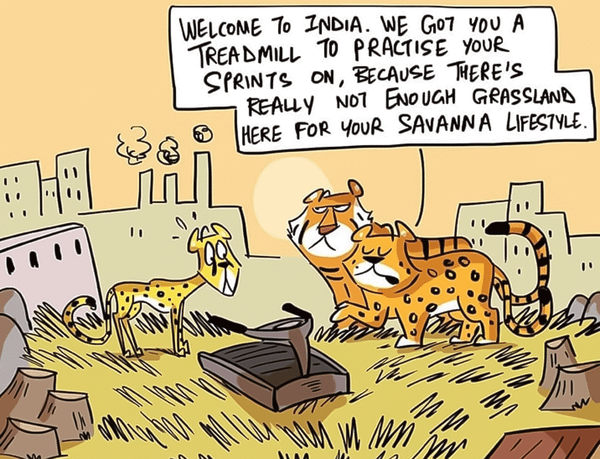
In parts of South Africa, a farmer needs 17 permits to sell a springbok carcass but only one to sell a sheep.
This is a typical example of differential regulation.
The extra checks and balances put in place by environmentalists have the perverse effect of reducing, in South Africa, the ability of springboks to compete with sheep for land.
Differential taxation and regulation are an anachronism that arises from the historical treatment of wildlife as a public good.
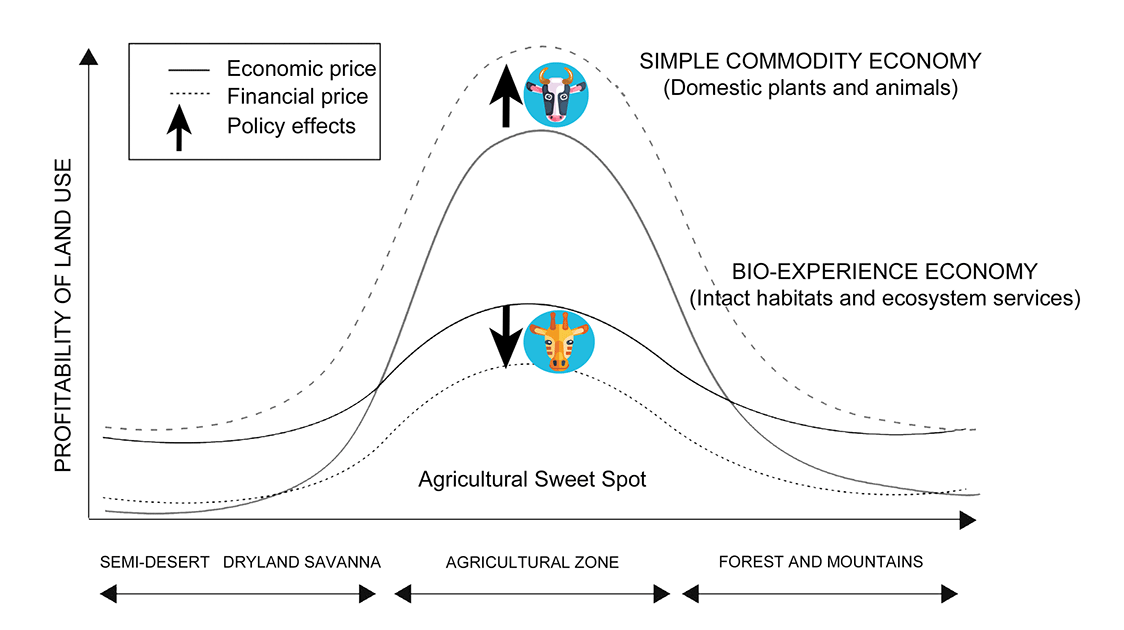
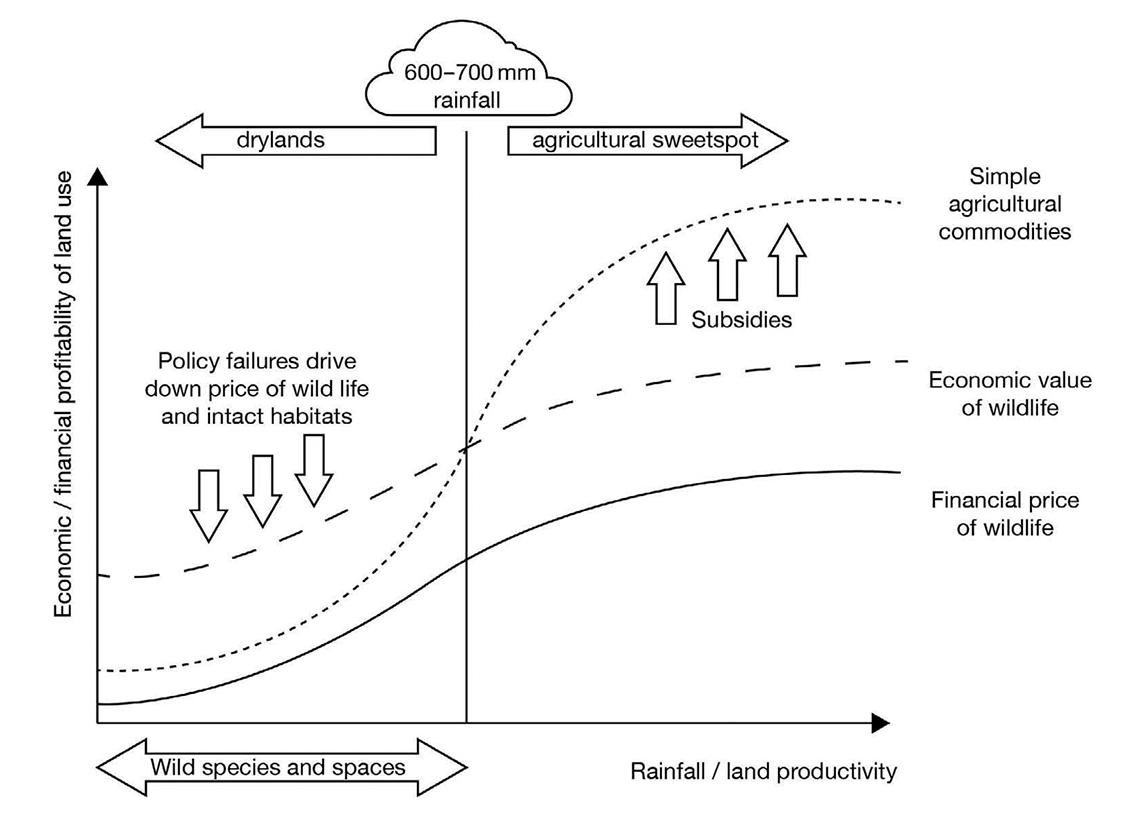
They shift the cost curves (Figures 1.1 and 1.2) very considerably to the disadvantage of wildlife, which is why more regulated species often recover more slowly than less regulated species in South Africa (Dry, 2010).
Regulators are irresponsible if they ignore the effects of fees and regulations on the economic competitiveness of wild species, and they should check themselves by asking if they would apply the same taxes, fees, or regulations to domestic corn or cows.
Market failure and the difference between economic and financial prices
The free-market approach, with its elegant mathematics and the democratization of choice, is ideologically captivating.
However, the assumptions that underpin the mathematical perfection of supply and demand break down in the real world, so that what is good for the individual is not always good for society.
This is called 'market failure'.
The difference between an economic price and a financial price (Box 1.1) is enormously important but seldom recognized by conservationists.
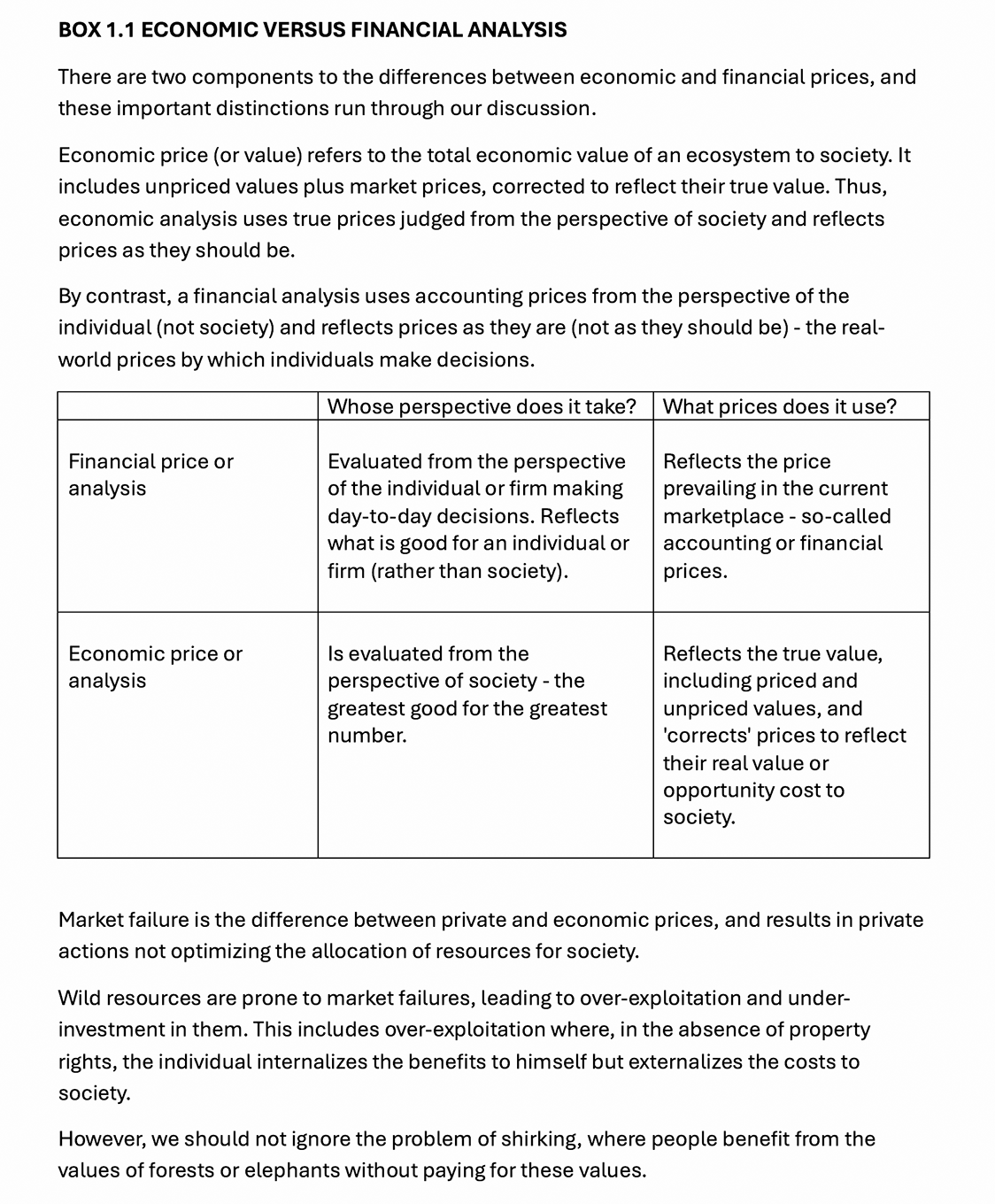
An economic (or social) analysis is holistic. It is undertaken from the perspective of society, and uses the real value of wildlife, priced and unpriced.
By contrast, a financial analysis is conducted from the perspective of an individual or firm and uses the actual market prices.
Wildlife is subject to substantial market failure, which is why it is often priceless to society (economic price) but worthless to the people who live with it (financial price).
In economic jargon, the true economic value of wildlife is not reflected in the financial prices by which land-use decisions are made.
Markets “fail” when they violate the assumptions required for perfect markets, including well-defined property rights, a large number of buyers and sellers, perfect information, perfect factor mobility, rational decision-making, and no transaction costs.
Market failure is especially problematic for wild resources for reasons discussed above: public management of private resources, open access and weak property rights, bureaucratic limitations on use and markets, missing markets, especially for ecosystem services, and differential taxation and regulation.
Can we use markets for conservation?
Arild Vatn (2015) suggests that the market has weaknesses in allocating wild resources for three reasons. First, Coase (1960) argues that property rights allocate resources efficiently in the absence of transaction costs; however, transaction costs are a significant part of getting anything done in the real world and would be high for complex and fugitive wild resources.
Second, it is theoretically true that if all resources are owned, and costs and benefits are fully internalized, the price mechanism alone can allocate resources efficiently.
However, splitting all aspects of the environment into pieces and then trading them according to prices is simply too many transactions for the free market alone to manage (Vatn, 2015, p. 222).
Third, economic efficiency is only part of the problem - we also need to consider who owns the rights in the first place (Vatn, 2015, p 350).
Vatn is right in saying that natural resource trade-offs are too complex, numerous, and subtle for the market to cope with. But so is the global economy, which has solved this problem by creating organizations.
In the first of his papers quoted by the Nobel committee, Coase suggested that firms have evolved for this very reason - to reduce the costs of millions of transactions (Coase, 1937).
Coase agrees that, in principle, all transactions can be conducted through the price mechanism.
However, firms exist because it is more efficient to bring people together in organizations to facilitate many of these transactions through social processes.
The same logic applies to wild resources.
So far, we have focused mainly on better rules and institutions - economic level 2 (Box 1.2).
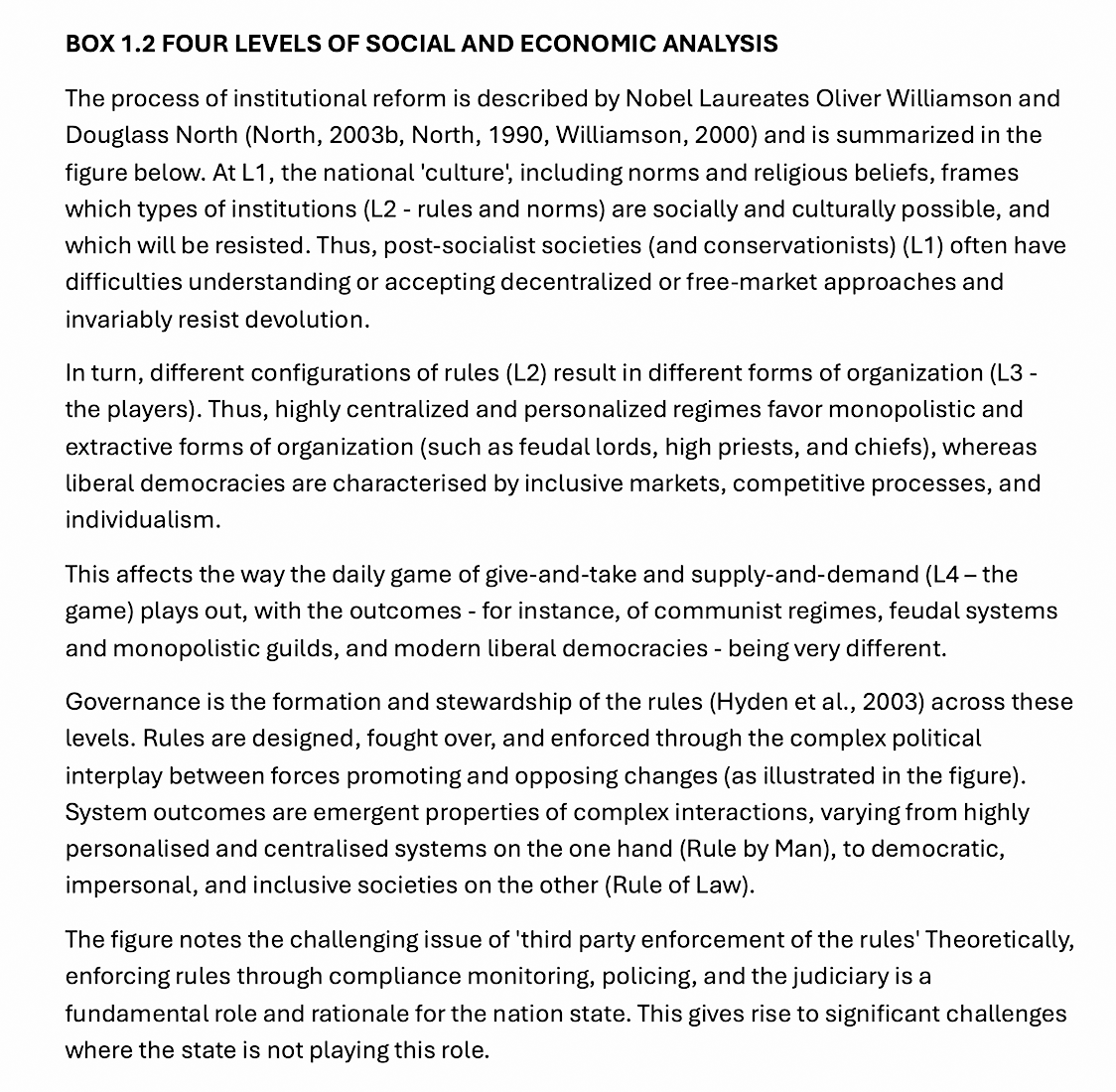
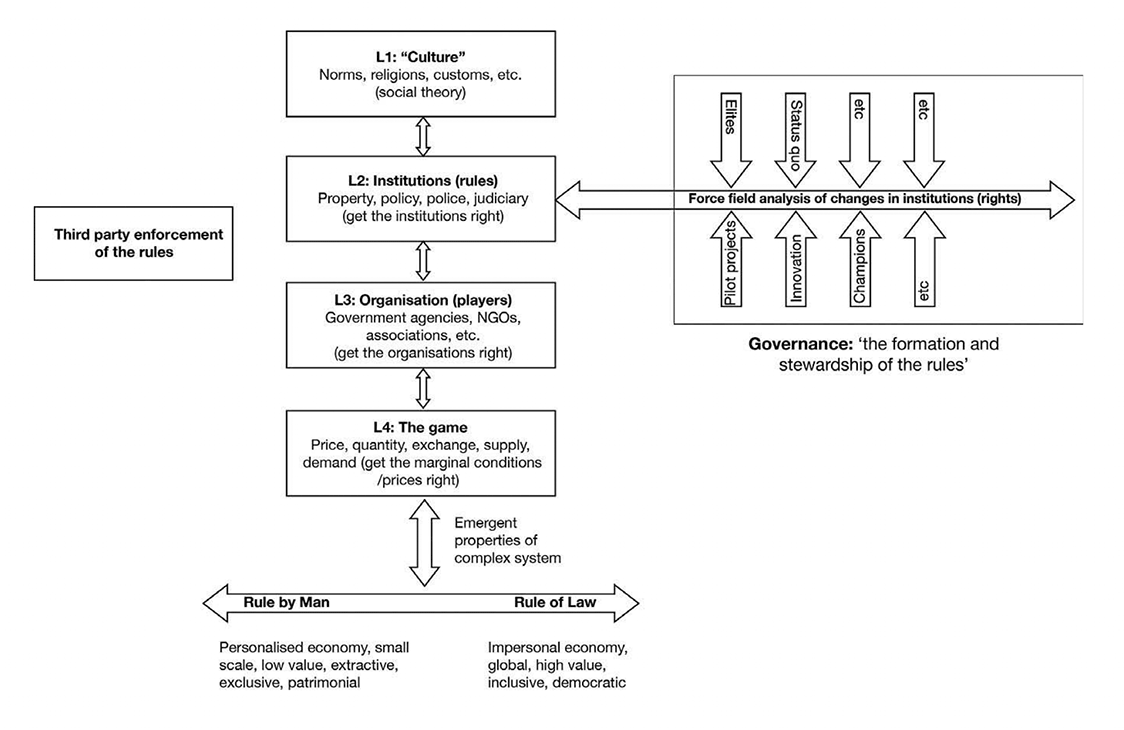
To internalize the costs and benefits of complex wild resources, however, these rules should also encourage new forms of local organizations (level 3) that fully internalize them.
Because wild resources combine the attributes of private goods and common-pool goods (Figure 1.3), there is considerable merit in combining (1) private ownership (by landholders and communities) and market exchange with (2) local, collective self-regulation, such as neighborhood associations, to manage numerous environmental effects and externalities.
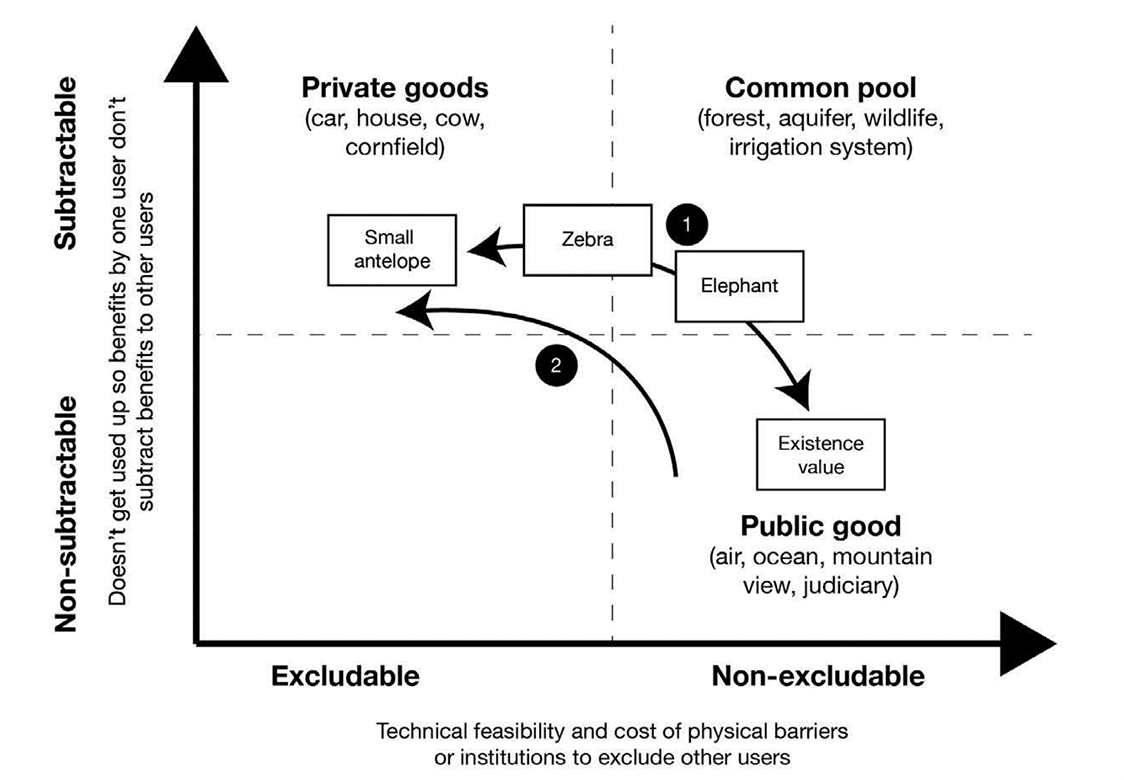
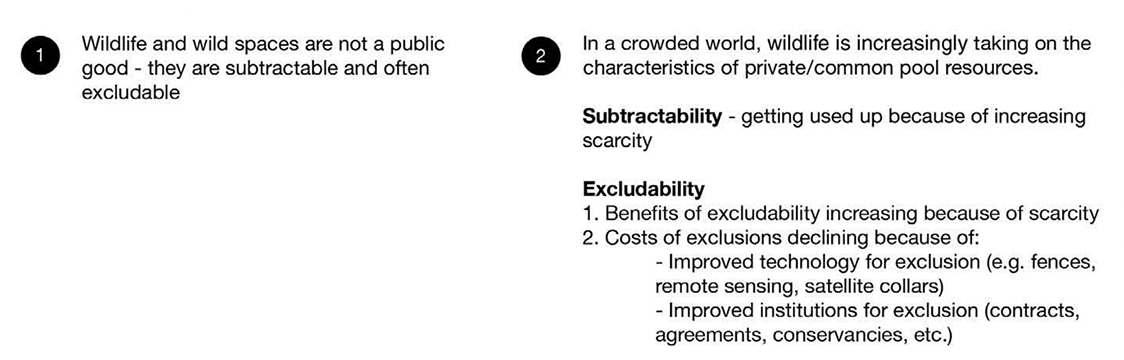
This combines the strengths of private production units with strong individual property rights for wild resources, with social mechanisms of reciprocity and collective action to manage the many costs and benefits of nature that are not captured privately.
An example of the second - ingenious - level of organization is the conservation catchment communities.
Groups of landholders living in the same catchment meet democratically to set rules to govern themselves, using peer pressure and collective action to internalize costs and benefits and reduce externalities associated with soil erosion, forest management, or mobile wildlife.
This combination of private property rights and collective self-regulation will not perfectly internalize all costs and benefits, but it is a massive improvement on either Leviathan or simple privatization (Child & Child, 2015).
Local collective organizations occasionally emerge spontaneously, but this process can be accelerated by a well-designed legal framework and technical support. Communities of practice and stakeholder groups also add value.
However, care must be taken to avoid the capture of such a process by special interests under the guide of stakeholders, if they are free riders and unaccountable for their power.
Thus, in designing local collectives, it is important to distinguish landholders, who have decision-making powers and are accountable, from stakeholders.
Free markets versus extractive capitalism
Private property and markets are powerful mechanisms for conservation, especially when combined with local social controls by resident landholders and communities.
Environmental markets can work well when combined with carefully crafted institutions and ancillary organizations, as described above.
Nonetheless, environmentalists and social activists are right to be fearful of extractive capitalism and should address these weaknesses rather than completely shying away from an approach based solely on property rights and free markets.
In the real world, markets are seldom as free as Adam Smith would have liked.
Even in democratic countries such as the United States, markets are shaped by the powerful for self-enrichment - Big Oil, Big Pharma, Big Banks, and so on.
In developing countries, elites are similarly protected by property rights while arguing against granting these same rights to the poor, leaving them vulnerable to exploitation (Menard & Shirley, 2011).
After the fall of the Berlin Wall, free-market economists rushed to privatize state assets in post-communist Russia with too much faith in markets and too little consideration of institutions and equity (Stiglitz, 2002, Chapter 5).

This created wealth, but this wealth was captured by oligarchs and led Russia down a path towards a mafia state.
With wild resources, therefore, we are not advocating simply for property rights, markets, and economic efficiency, but for community property rights that incorporate social equity to ensure that the communities that live with wildlife are the rightful beneficiaries.
Likewise, family-owned enterprises with a sense of neighborliness and a sense of place are likely to factor unpriced environmental costs and benefits into economic equations (especially if these processes are enhanced by education and collective action).
By contrast, corporates, with absentee management, and a focus on scale or short-term profit metrics, are not.
Conclusions
The common view is that wild resources and ecosystem services are too important or too complicated to be governed through the market system. This is not supported by the facts.
Both environmentalists and economists have mistakenly accepted (and even promoted) the separation of nature and economics.
Wild resources protected from the "selfishness and greed" of man have usually fared far worse than those incorporated into the global market system through ownership and trade (e.g., agriculture, forestry, livestock, and urban property).
Wild species and ecosystem services may theoretically be worth several times formal global GDP (Costanza et al., 1997), but in practice, they are worth very little, especially to the people who live with them.
I have argued that wild resources are disappearing because they are not part of the market system that guides much human activity.
There is merit in reinserting wild resources into the market economy, provided institutional conditions are well designed.
Private exploitation of wildlife was discredited by the damage it caused under frontier conditions, but private exploitation of a public resource differs fundamentally from utilization through private ownership (Stroup & Baden, 1983).
When enforceable property rights are combined with trade, 'selfish' private actions can lead to the common good and rapid wildlife recovery (Carruthers, 2008).
However, private action and ownership alone is a very crude instrument.
To properly account for environmental effects, it needs to be combined with mechanisms of social accountability, such as local self-regulation, which is a far superior mechanism for controlling externalities than governments with coercive and regulatory powers (Ophuls, 1973, and Hardin, 1978, quoted in Ostrom, 1990, pp 8-9).
With their long feedback loops, centralized systems struggle to properly internalize the costs and benefits of land use.
Their accountability often lies elsewhere, and neither is central control immune to self-serving officials and special interests.
As Ostrom suggests, 'there is no reason to believe that bureaucrats and politicians, no matter how well meaning, are better at solving problems than the people on the spot, who have the strongest incentives to get the solution right'.
There is no one-size-fits-all approach to the challenge of natural resource governance (Ostrom, 2009).
Improved governance of wildlife requires combining and sequencing privatization, collective action, and public ownership in ways that are much better aligned to wild resources:
- First, we put as much as possible in the private box through individual freehold or private-community ownership, ensuring prices are set at the lowest possible level. This requires maximizing the value of wild resources through specialization, exchange, and market development, and ensuring that this value gets to landholders. Clear proprietary boundaries and strong property rights are necessary to internalize costs and benefits.
- Second, we use collective action, democratic peer pressure, and local regulations to manage externalities and complexity as far as possible, and as low as possible. People who live and work on the land are better at this than absentee landlords.
- Finally, the center should frame the rules to support devolution and devolved regulation. It also has the responsibility to ensure that outcomes are monitored to inform adaptive policy reform. We fall back on central regulations only when all other measures fail.
Thus, wild resources are privatized to landholders and communities, thereby favoring wild species over domestic ones.
Second-order problems of externalities and attribution are managed through collective action.
This significantly changes the role of the state, which needs more capacity to design and protect economic institutions and less for the day-to-day management and policing of wild resources.
The state retains the residual responsibility for effects that are not internalized through privatization and collective action, with the challenge being to remain effective without undermining the devolved approach by being high-handed.
The politics of these changes will not be easy. However, we now understand the economics and institutional economics of wild resources sufficiently well that we can at least propose technical solutions with considerable certainty that they can work if applied correctly.
Prof Brian Child is an associate professor in the Department of Geography and the Center for African Studies at the University of Florida, and the director of the Life Through Wildlife Project. His book, “Sustainable Governance of Wildlife and Community-Based Natural Resource Management”, is available on Amazon.