Commercializing the Bushmeat Trade: You Can’t Eat Pins
By Prof Brian Child
Exchange and specialization as the basis of wealth
Published in 1776, Adam Smith wrote The Wealth of Nations. He showed that wealth is created by converting raw materials, often drawn from the environment, into goods people want.
The secret to wealth creation was the productivity of labor, which he illustrated using the famous example of the pin factory.
Through specialization (the "division of labor') and cooperation, a pin factory produced 48,000 pins per man per day, compared to about 20 by a man working on his own (Beinhocker, 2006). But specialization requires trade.
Pin makers couldn't eat pins, but needed to trade them for bread, fish, and everything else they needed. Trading what you're good at, for what you need, is essential for wealth creation, and the only species that has developed the cognitive ability to trade - man – is also the wealthiest.
If you give one orangutan two oranges and the other orangutan two bananas, they will hang on to what they have for dear life, never trading for a better situation.
If you give one human two cups of tea, and the other two cream scones, they will bargain and trade so that they are both better off, eating a scone with their tea.
The process of consensual exchange, by definition, makes both parties better off. It creates wealth.

Efficiency and the invisible hand
Having addressed the first great question of economics (How is wealth created?), Smith tackled the second: What is an efficient, and just, allocation of resources, and how does this occur (Beinhocker, 2006)?
Smith was writing at the end of the Enlightenment, when the question of authority and legitimacy was being resolved in favor of individuals rather than the king, the state, or the church.
Smith presented the attractive argument that people – not authorities - are the best judges of their own choices.
As a frugal Scotsman, he also believed that resources should be allocated efficiently, not wastefully, to maximize the total wealth of society.
Smith's argument was captivating.
The best way to organize the economy, he said, was for people to trade freely, with self-interest and prices guiding them to provide the goods and services they needed.
Competitive markets, Smith concluded, were the most morally just mechanism for allocating society's resources. People were free to make their own choices.
Free markets gave people more of what they wanted and allocated society's resources more efficiently. In an insight that lies at the heart of free market economics, Smith (1776) suggested:
[The merchant] intends only his own gain, and he is in this, as in many other cases, led by an invisible hand to promote an end which was no part of his intention ... By pursuing his own interest, he frequently promotes that of society more effectually than when he really intends to promote it. (Smith, 1776, Book IV, Chapter II, para. ix)
The invisible hand was, of course, the mechanism of supply and demand operating in competitive markets.
In 1862, the English mathematician and economist, William Stanley Jevons, published A General Mathematical Theory of Political Economy, while the French economist, Leon Walras, published Elements of Pure Economics in 1854, believing that turning economics into a mathematical science was a good thing.
Smith's ideas evolved into a theory of general equilibrium, strengthened in the 1960s by a series of famous economists, including Marshall, Samuelson, and Arrow, who established that prices act like a nervous system, causing all the markets in the economy to automatically coordinate themselves, thus allocating all the resources perfectly to their best uses. (Beinhocker, 2006).
This concept is captivating and is the essence of free-market ideology.
However, it is also a simplified and mathematical abstraction, because it depends on numerous assumptions that are only approximated in the real world - perfect information, homogeneous products, costless transactions, the absence of externalities (i.e., perfect property rights), economies of scale, and so on.
Real markets range from close to perfect (where these conditions are near to being met) to greatly imperfect (where they are not, as is the case for wild resources).
Supply, demand, and free markets
Markets are places where producers and consumers come together to trade, with price the point at which supply meets demand.
This is microeconomics, with its ubiquitous supply-and-demand curves.
In a perfectly competitive market, more firms will enter the market to supply a good as its price increases.
Conversely, as the price increases, fewer customers will buy the good.

The equilibrium point is where the quantity of the good demanded by consumers (at that price) exactly equals the supply of that good (at that price).
Resources are allocated to their highest valued uses, and no resources are wasted. This is expressed mathematically using the supply (S) and demand (D) curves of economic textbooks.
Prices, however, are not static. If, for instance, fashions change and the demand for tourism increases, the equilibrium point and price for tourism also increase.
Prices are not a capitalist trick.
They reflect the socially negotiated value of resources and provide the mechanism for making resource trade-offs and allocating land to its highest value uses.
This is why the pricing and mispricing of wild resources are so important.
Prices only become a capitalist trick when the underlying structures - property rights, markets, and rules – are incomplete, or capitalists can manipulate them.
Who designs free markets?
There is some confusion about the definition of 'free markets'. One interpretation, that of laissez-faire, is the ideology that markets should be free from government interference (Beinhocker, 2006).
This was not Smith's interpretation, and nor is it ours.
For Smith, supply and demand should be determined solely by price and quality, free from distortions caused by monopolies, price controls, government price-setting, and so on.
This raises the question of how the rules that frame free markets arise.
They will not just emerge in perfect form.
In a laissez-faire situation, rules will be 'written' by the rich and powerful, who benefit most from markets at the expense of the many.
Alternatively, we might hope that highly professional public administrators in inclusive democracies write the fairest rules possible (and we should certainly strengthen natural resource agencies for this purpose).
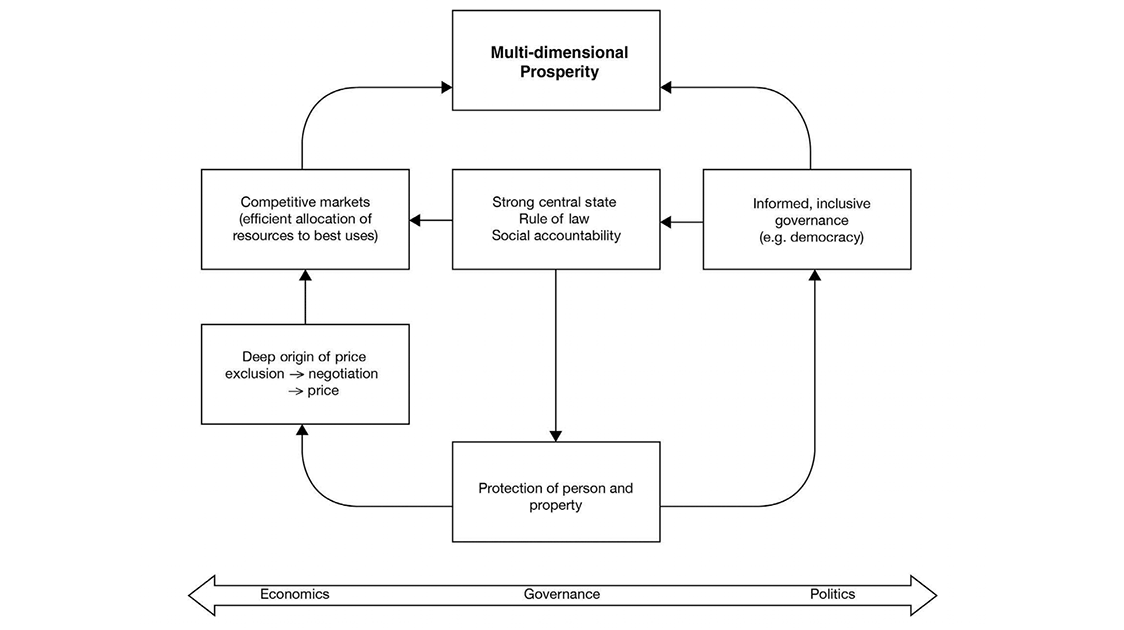
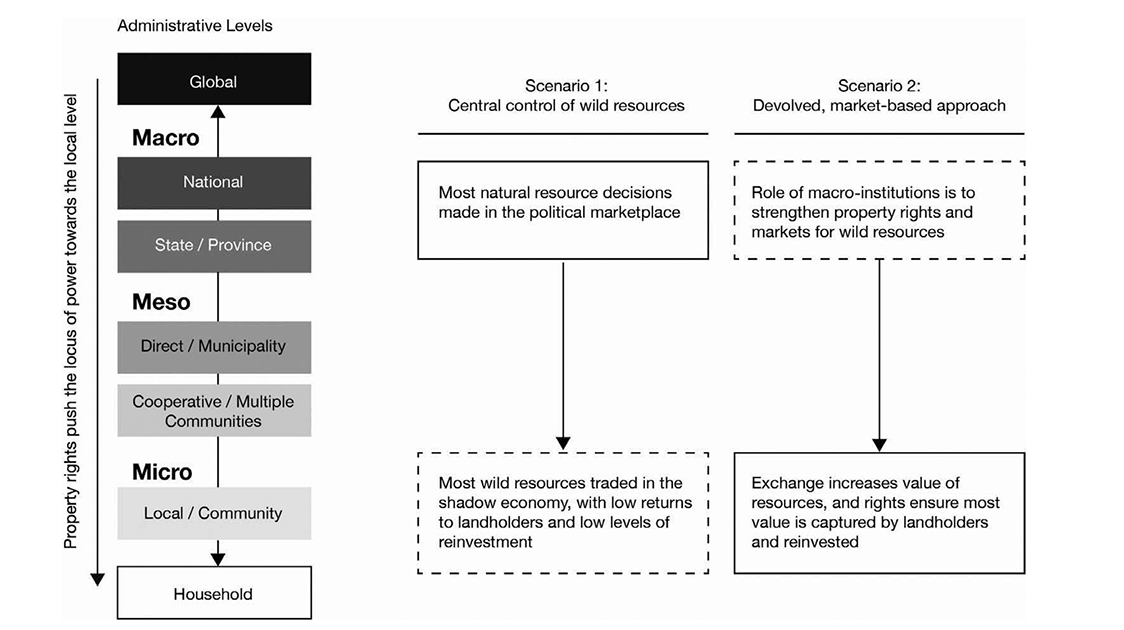
Indeed, one of the primary justifications for the rational-legal state is the need for a collective authority to establish and enforce impersonal rules that meet Smith's conditions (see Figure 2.1).
However, making good rules in the real world is difficult. Non-ideal situations persist because they benefit the power groups that maintain them.
Thus, ungoverned spaces persist because they enable rent-seeking.
Centralized environmental governance, likewise, benefits those in charge. This creates resistance to change.
For example, most environmentalists are viscerally opposed to a wildlife economy and its central tenets – local ownership, the utilization of wildlife for profit, and global markets.
If they allow wildlife to re-enter the global processes of local choices and exchange on an even economic playing field, their role as the Lords of Conservation will surely shrink (Figure 5.8).
Local commons and global benefits
Are wild species so important for the global good that we cannot afford to allow local people to own them?
I make the opposing case: that local ownership and the re-creation of the local commons are essential mechanisms for global benefits.
Without local ownership, wild resources are essentially free and unprotected, and users can take as much of them as they want without contributing to their upkeep.
This is business as usual.
Devolving ownership of wild resources to landholders and communities, by contrast, will lead to proprietorial protection and to prices that allocate them to their best use.
I will illustrate these concepts in the context of the seemingly unsolvable, rapid decline in forest wildlife driven by the bushmeat trade.
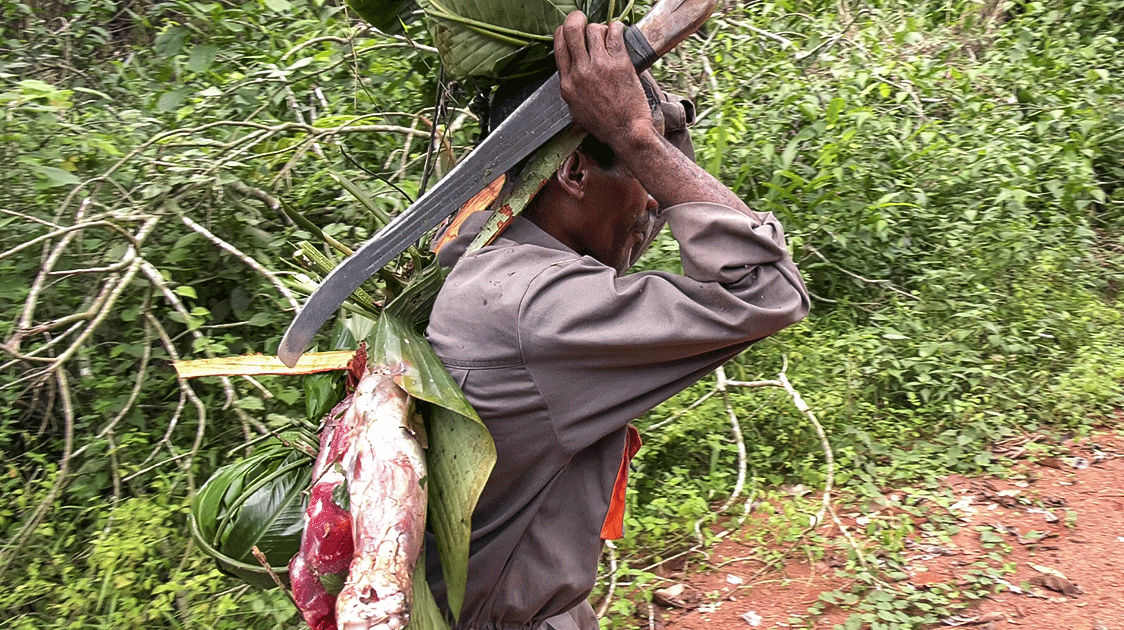
I will propose the unthinkable and challenge current norms by giving communities the rights to use, manage, and benefit from bushmeat and the capacity to exclude others from simply taking it, together with considerable encouragement to trade it to make as much money as possible.
Under these new conditions, consumers will need to negotiate with the producer community to buy bushmeat, because they now own their wildlife and can exclude other people from taking it without paying.
The price of bushmeat emerges through these negotiations - for example, four bags of maize for one duiker carcass - and now incorporates the costs of producing wildlife, not merely the costs of hunting it in an open-access situation.
These prices, in turn, guide resource allocation.
The relative price of duikers and goats, for instance, enables the community to decide whether to use their land to produce duikers or to replace duikers with goats.
The more people want bushmeat, the higher the price of wildlife, and the greater is the incentive for managing wildlife, not goats, sustainably.
Once bushmeat becomes a profitable community business, it is in the community's interest to protect the forest to produce more wild animals.
In this way, the rising demand for bushmeat is converted into incentives for the community to conserve wildlife and its habitats.
Should we encourage wildlife trade?
Proprietorship is a necessary condition for the 'true' price of duikers, or buffalo for that matter, to emerge, but it is not a sufficient condition.
The second question is whether we should encourage exchange and even global trade in wildlife.
The pin makers can't eat pins.
Likewise, without trade, forest communities are highly unlikely to get the best price for their wildlife or, therefore, to specialize in wildlife production.
Banning trade is a sacred cow of conservation ideology, but that does not make it right.
Exchange creates wealth, and the more global the markets are, the more value is created.
We can illustrate this strikingly by comparing the value of a buffalo in a no-trade scenario (subsistence use only) with its value in a scenario in which exchange is actively encouraged.
When communities hunt down a buffalo, it is worth, at most, $500, or the value of the carcass.

However, trading on the global market, they can expect American or European trophy hunters to pay about $7,500 for a buffalo (plus a similar amount in outfitting fees) and still keep the meat.
Now, the buffalo earns the community $8,000, or nearly 20 times the no-trade, subsistence value.
In addition, we need to factor in the economic impact of an additional $7,500 in outfitting fees, wages, tips, travel, and significant ancillary expenditures, as well as multipliers on the local economy.
This example shows that the exchange process alone increased the value of the buffalo some 20-40 times, with the corollary that restricting markets destroys wealth by the same amount.
This has major land use implications.
A $500 buffalo probably cannot compete with cows for land, but an $8,000 buffalo can, provided communities formally own the wildlife, receive 100% of these payments, and prevent other people in the value chain from grabbing this money.
Correcting these policy failures requires two reforms.
First, we need to maximize the price of wildlife through global markets by removing trade restrictions and developing markets and products (price).
Second, we need to ensure this money reaches the community (proprietorship).
With buffalo now worth $8,000, compared to cows at $500, there is a strong incentive for communities to rewild their economies.
Wildlife has thrived under these conditions in southern Africa, but not where policies sound good, but governments only allow communities to retain, say, 20% of the value of the buffalo.
Banning trade might have worked in an empty world, but in a global and full world, the biggest threat to wildlife is habitat replacement.
We cannot fight this if forest communities are locked into using wild resources in traditional, unspecialized, low-value ways (Box 6.2). Exchange and trade are necessary to multiply the value of wild species.
However, trade has a positive impact only when it is twinned with proprietorship, because in its absence, it can accelerate unsustainable resource extraction.
BOX 6.2 THE FALSE ECONOMY OF SUBSISTENCE USE AND ALTERNATIVE LIVELIHOODS
To avoid the discomfort of banning the age-old livelihoods of hunter-gathering communities, a compromise is often reached in which subsistence use of wild species is acceptable, but commercial exchange is not.
Subsistence hunting, like low-input agriculture, is a low-value and wasteful use of resources. Large numbers of animals are harvested for low gain because wealth creation is reduced by an order of magnitude in the absence of free exchange.
With buffalo, for instance, we can support the same livelihoods from two trophy buffalo as we can by harvesting 40-50 for bushmeat.
Consequently, trophy hunting is highly sustainable biologically and economically, but wild meat production is not.
Trapping local communities in low-value subsistence uses does little to address poverty, and even less to enable wildlife to compete economically with domestic resources, such as crops and livestock, for land.
Another motherhood strategy associated with attempts to conserve wildlife is the somewhat empty idea of 'alternative livelihoods'.
If alternative livelihoods were so easy to generate, people would have found them. Moreover, the alternative to wildlife-based livelihoods is to replace wildlife with domestic species.
What problem does this solve?
Counter-intuitive as it may seem, the best 'alternative livelihood' to low-value bushmeat and the illegal wildlife trade is often the high-value, legal use of wildlife.
What would happen if, rather than limiting forest communities to the subsistence use of bushmeat, sophisticated markets allowed people all over the world to buy healthy, forest-grown meat, rather than meat-like substances produced in factory farms?
First, the price of bushmeat would skyrocket.
Provided communities owned the wildlife and the land it lived on, and could exclude others from taking it, this would increase incentives to allocate land to wildlife and protect it.
Forest communities could then specialize in managing forests and bushmeat sustainably, rather than replacing wild meat with domestic plants and animals.
It would pay them to act like livestock owners the world over - maintain the stock of animals and sell the surplus.
As with private livestock, the most likely problem is too many animals on the range, not too few.
To conclude this argument, I introduce some economic terminology: forest communities have a comparative advantage in producing bushmeat and forest products.
Increasing the price of these through well-managed exchange dematerializes the economy, shifts land to higher-value uses (wildlife), and enables these communities to make more (livelihood) from less (environmental raw materials) compared to low-value commodities.

Moreover, selling high-value bushmeat through legal channels, rather than badly prepared meat in the shadows, might well reduce criminality.
This transformation depends on institutions - the property rights and markets that convert low-ordered raw materials into more highly ordered products and services (Beinhocker, 2006).
Free markets won't solve all conservation problems, but there are important opportunities to use them to improve the management of wild spaces and wildlife outside protected areas.
An effective market-based approach has several requirements, namely that:
- Most of all, proprietorship is devolved to the people living with wildlife and forests.
- Wildlife is traded, wildlife products and missing markets are developed, and ideologically imposed restrictions on uses are removed.
- Costs and benefits are fully internalized through a combination of property rights, collective self-regulation, and regulation (in that order).
- People and wild resources compete based on price and quality, not power, personal connections, or brute force.
- Wild resources are not disadvantaged compared to domestic resources by differential taxes or regulations (including trade bans).
Prof Brian Child is an associate professor in the Department of Geography and Center for African Studies at the University of Florida and the Life Through Wildlife Project director. His book, “Sustainable Governance of Wildlife and Community-Based Natural Resource Management”, is available on Amazon.