Priceless but Worthless


By Prof Brian Child
Wildlife and wild resources are priceless but worthless because environmentalists and economists have excluded them from the mainstream economy.
Conservationists abhor the dollarization of wildlife, while economists treat the economy as a closed system, ignoring the true costs of the waste they dump into oceans, rivers, and the atmosphere, and of the raw materials and services they extract from nature.
Prices guide the allocation of resources in a global world, and we can no longer afford to leave wildlife beyond the economic sidelines.
Taking wildlife out of the marketplace
John Muir, the father of the ‘preservation’ movement, sired the ideology of keeping nature separate from economics and ‘saving the American soul from total surrender to materialism’.
In a famous argument over the conservation of Hetch Hetchy Valley in Yosemite National Park, John Muir set his preservationist ideals against the utilitarian economic argument for damming the river to provide water to Californian cities, remonstrating lyrically against the desire to dollarize everything (Muir, 1912).
By contrast, Theodore Roosevelt promoted the ideal of ‘conservation’ as wise use, setting in place the divide between conservation and preservation that continues to this day.
Nevertheless, Roosevelt responded to the wildlife crisis of the late 18th century by removing wildlife from the marketplace, outlawing market hunting, and preventing interstate commerce in wild plants and animals (but not timber production or fisheries).
In essence, wildlife and other environmental resources became ‘public goods’ outside the market, implying no rivalry in use and no need for mechanisms of exclusion (Vatn, 2015, p 52).
The mainstream economy and the environment
Theories of neoclassical economics share the viewpoint that nature is not part of the economy.
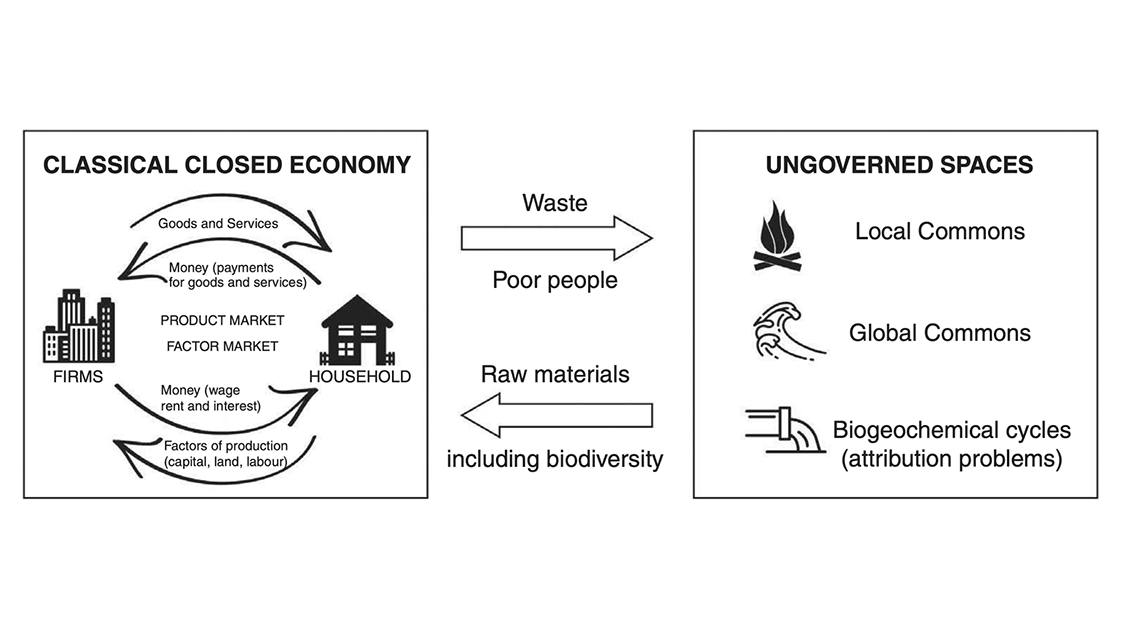
Most standard economics textbooks depict the economy as a closed system of exchange between firms and individuals (left side of Figure 1.1), but ecological economists have pointed out that the economy is not a closed system and therefore cannot simply grow itself out of trouble as is too often assumed (Ropke, 2004; Daly, 2005; Vatn, 2015).
The real-world economy extracts vast quantities of raw materials from the environment and dumps huge amounts of waste into it, where it also hides millions of poor people (see right side of Figure 3.2).
The economy also depends heavily on a living planet for pollination, agriculture, flood protection, and so on (Costanza et al., 1998).
The economy, however, fails to pay many of these costs, externalizing them predominantly into ungoverned spaces – the global commons of atmosphere and ocean, and the local commons where poor people live in forests and drylands, often alongside wildlife and national parks.
Ungoverned spaces
The over-extraction of resources and dumping of waste (and poor people) occurs differentially into ‘ungoverned spaces’ which, for our purposes, are defined as the places where costs and benefits are not fully internalized and we can get away, for the meantime, with not paying the true costs of these actions.
We are exceeding planetary boundaries disproportionately in ungoverned spaces, including the atmosphere and oceans, which are genuine global goods and, for our purposes, the ‘local commons’, where the institutions for land and wild species are outdated, crude, and mismatched to the characteristics of the resources in question.
We know that the differential performance of social systems and economies is closely related to the quality of institutions (North, 1990), and our argument is to apply this very same institutional logic to wild resources and communities.
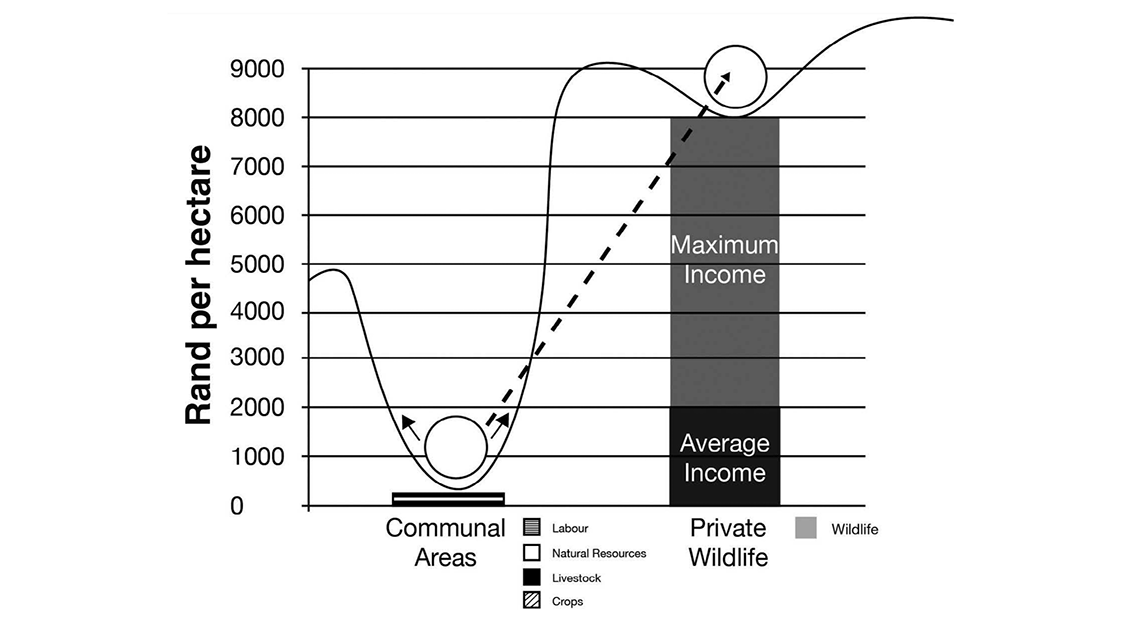
This argument can be illustrated using data comparing the economic productivity of land with rich and weak institutions in drylands in South Africa (Figure 1.2).
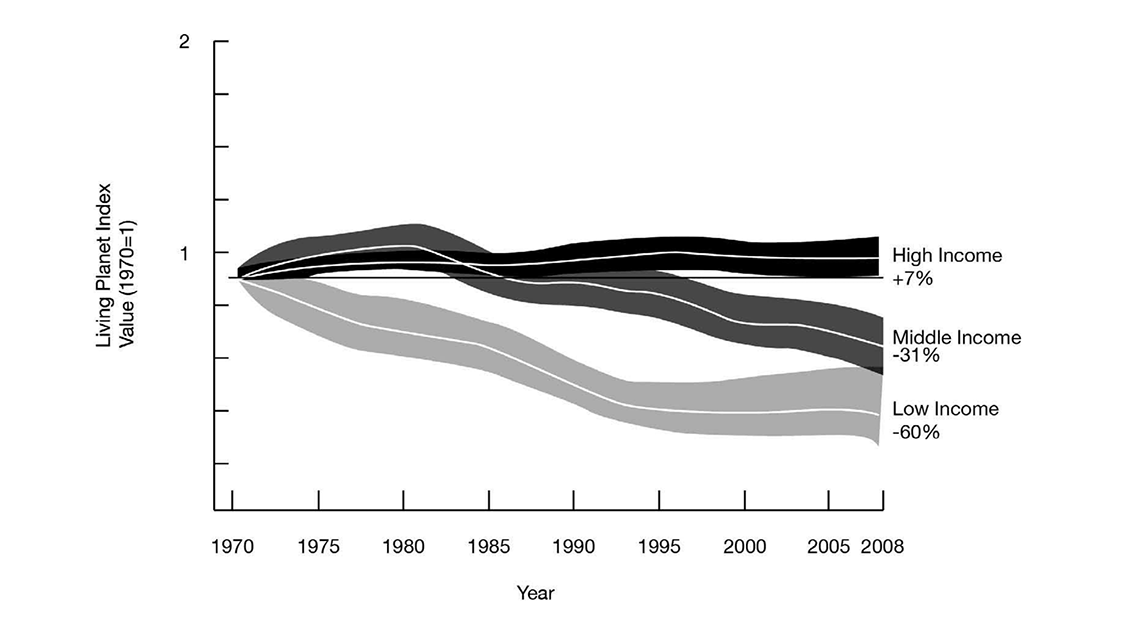
Trends in the Living Planet Index suggest this pattern is global.
Biodiversity is recovering slightly in countries with rich institutions despite a high per capita environmental footprint, whereas middle- or low-income countries with weaker institutions are losing species rapidly despite low per capita consumption (Figure 1.3).
In the early stages of economic growth, today’s rich countries also had weak institutions and over-exploited their forests and environments.
However, as they developed more sophisticated and polyvalent institutions, and began to internalize the costs and benefits of the environment, there was some ecological recovery, following public actions and investments in protected areas and endangered species, and, not least, new rules that began to establish markets for nature and pollution.
Rich countries, perhaps nearing the limits of what public management and regulation can achieve, are experimenting with new kinds of property rights, markets, and governance arrangements for environmental effects that were unpriced until recently.
Examples include pollution taxes, cap-and-trade markets, individual tradeable quotas for fishing, multiple stakeholder approaches, as well as payments for environmental services, biodiversity offsets, certification and standards, and so on.
Some of these market-based solutions have been quite successful, including the protection of ozone through the 1987 Montreal Protocol, cap-and-trade systems incorporated into the Clean Air Act in the USA in 1990, and the idea of individual tradeable quotas for fisheries (McKean, 2000; Tietenberg, 2006).
Other economic mechanisms for ecosystem services are beginning to emerge in the form of payments, certification, and biodiversity offsets, and their effectiveness is still developing (Wunder et al., 2010).
The combination of property rights, markets, and social action has controlled or internalized many of the costs of waste and resource extraction in prosperous nations.
The effect of these ‘rich’ institutions has been to partially price ecosystem services and to prevent environmental harm, leading to some environmental recovery.
For example, strong property rights prevent people from dumping or extracting resources in an uncontrolled manner, even before we consider the development of ‘markets’ for pollution, tradeable quotas, and environmental offsets.
Even then, it is quite likely that much of the environmental footprint of high-consumption societies is being exported into ungoverned spaces where the costs and benefits of resource extraction and the dumping of waste materials are not fully internalized.
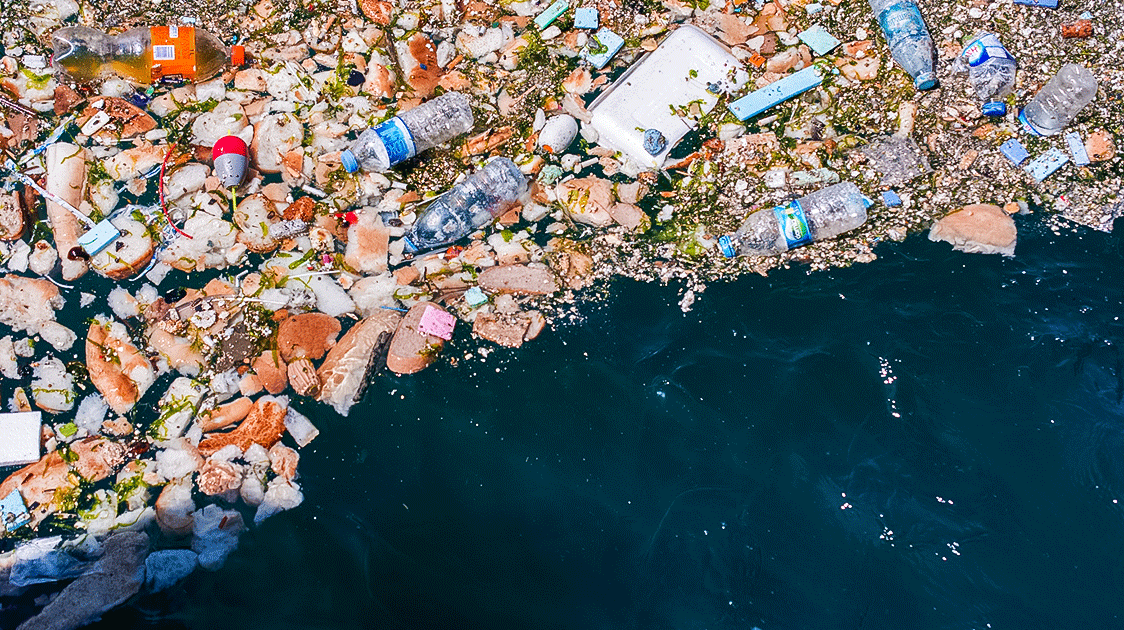
Examples are numerous, and include plastics in the sea, the migration of dirty manufacturing to poorer countries, and climate change, where poorer people, especially Africans, will pay a much higher cost than the societies that contributed the most to this problem.
Similarly, wealthy, urban societies tend to free ride on the services provided by forests and wildlife, which they expect poor people and poor countries to provide as a global public good.
Ungoverned spaces and their genesis
The environmental recovery of modern urban society stems, to a significant extent, from the underlying strength of institutions such as secure property rights, the rule of law, and inclusive governance.
Similarly, we can blame much of the loss of ecosystem health and diversity in the ungoverned spaces of low-income countries on institutional failure.
The causes of this are described as ‘deinstitutionalization’, pointing to the loss of rights by local communities over land and wild resources, and to the devastation of social capital and local systems of governance through a history that includes slavery, colonialism, conquest, diseases, one-party dictatorship, and, more recently, the continued erosion of rights through the globalization of environmental policy.
The loss and potential recovery of wildlife is an economic problem that can, in many places, be resolved by reinstitutionalizing wild resources and by establishing communities as viable natural resource management units, i.e. Community-Based Natural Resource Management (CBNRM).
These new approaches respond to the misclassification and continued public management of wild resources outside public lands, when they are neither non-subtractable nor non-excludable (Randall, 1983; Ostrom & Hess, 2007).
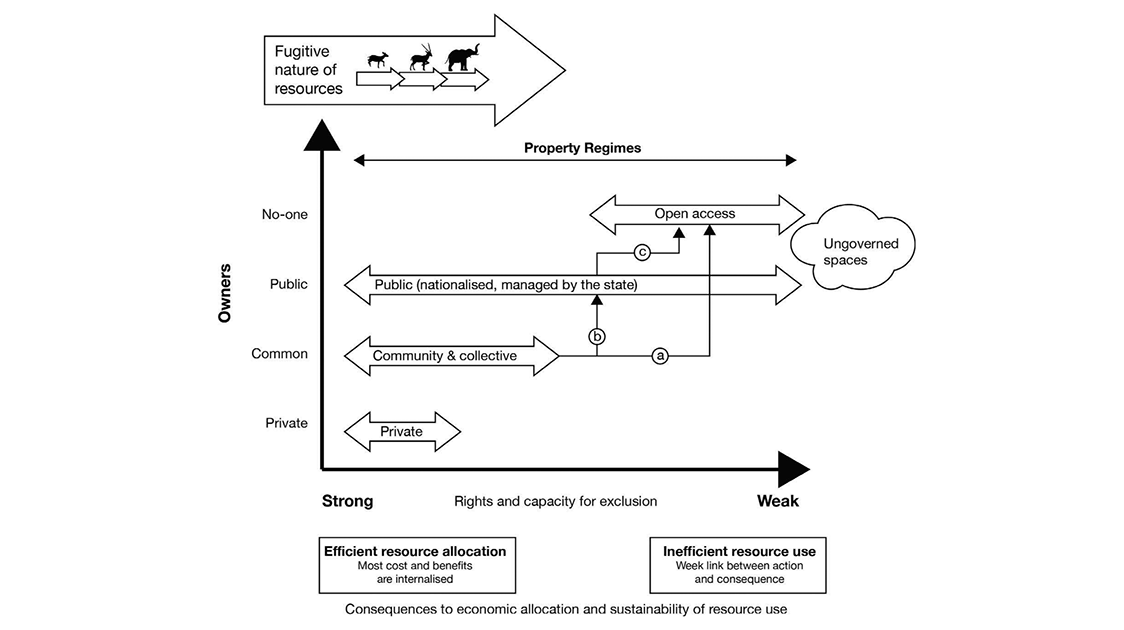
They also respond to weaknesses in public capacity (especially exclusion) and the degradation of already misaligned and vulnerable public governance systems into de facto open-access regimes, so that wild resources and wild spaces have become, essentially, ungoverned and highly susceptible to replacement and overexploitation (Figure 1.4).
As the son of a man who established protected areas in three countries, I am a strong proponent of national parks.
However, like my father, I recognize that we need new approaches to conserve wild species on the 85% of the planet that is not in parks and protected areas, and that we need to use scarce conservation dollars as efficiently as possible by enabling wildlife to pay its way wherever it can.
Prof Brian Child is an associate professor in the Department of Geography and Center for African Studies at the University of Florida and the Life Through Wildlife Project director. His book, “Sustainable Governance of Wildlife and Community-Based Natural Resource Management”, is available on Amazon.