Is Wildlife Law Enforcement Succeeding in Natal? (1978)

By Nick Steele
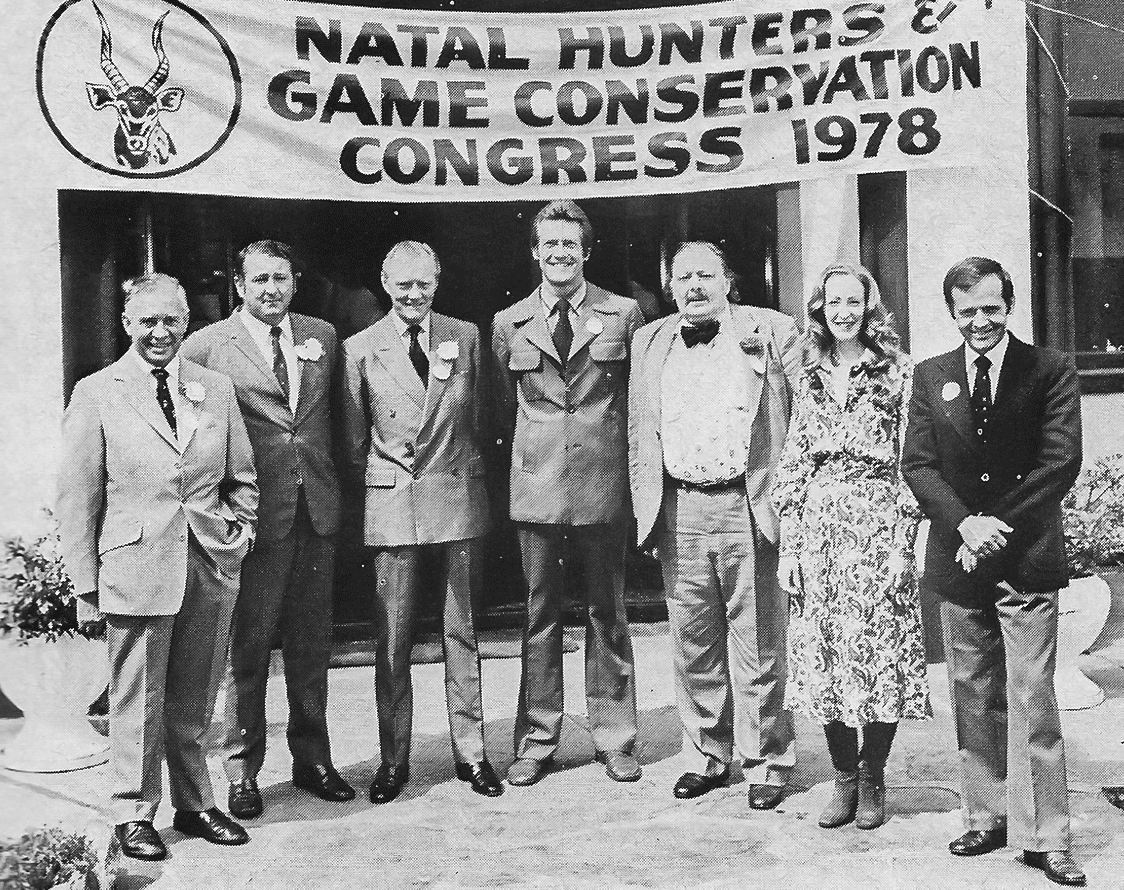
Nick Steele’s paper was delivered at the Natal Hunters and Game Conservation Association Congress in October 1978.
At the time, Steele was serving as Conservator for the Natal Midlands region within the Natal Parks Board.
He had been transferred from the Zululand reserves to the Natal Midlands near Greytown, where he was responsible for conservation oversight on private and agricultural land in that region.
This posting fomented in Steele’s mind the idea that wildlife conservation had to extend beyond state reserves onto private land.
He began developing what became the “conservancy concept”, encouraging neighboring farms to cooperate in protecting wildlife outside formal reserves.
The first conservancy was established at Balgowan in August 1978.
This ultimately triggered the conservancy movement across South Africa.
In the late 1970s, the human population in today’s KwaZulu-Natal was around 6 million. In 2026, it is about 12.4 million.
The population living in the districts surrounding Hluhluwe-iMfolozi Park has increased from a few hundred thousand people in the 1970s to well over two million today.
The issues Steele highlighted in his article have since become more acute.
Has anything been learned in nearly 50 years?
Is Wildlife Law Enforcement Succeeding in Natal?
Conservation Law Enforcement in the Province of Natal is covered by Ordinance 15 of 1974. Within the pages of this weighty document are 12 sections covering the Conservation of everything from game and reptiles to wild birds and indigenous plants.
These laws are supported by some 17 regulations and 13 schedules, the latter designating Specially Protected Game, Endangered Mammals, and Specially Protected Indigenous plants.
To enforce these conservation laws in the 38 000 sq. km of Natal, the Natal Parks Board (NPB) employs game rangers, game guards, and zone officers.
Since the 47 game and nature reserves occupy only about 2% of the total area of Natal, the remainder of our law enforcement takes place on private land, tribal land, and state lands.
Our law enforcement staff are equipped with good vehicles and, in some cases, radios.
Conservation ordinance infringements in Natal can roughly be broken up into the following:
- Poaching by townspeople, government officials, etc., on farmland and on public roads
- Poaching by tribal people into the game reserves and onto farms
- Law infringements by landowners who deliberately flaunt the law in the erroneous belief that they are immune
- Smuggling of Protected and Specially Protected plants by in-transit tourists and by organised gangs
- Illegal bird netting and black marketeering
- Bark stripping of valuable trees and plants by herbalist middlemen
- Infringements by fishermen on the rivers and along the coast of Natal
You will probably have read from time to time of our successes against these lawbreakers:
- A white farmer losing his vehicle, rifle, and being heavily fined for shooting a steinbok
- A fisherman caught with 25 shad, 23 in excess of the bag limit
- A tribesman convicted for poaching in a game reserve with assegais and dogs, and so on
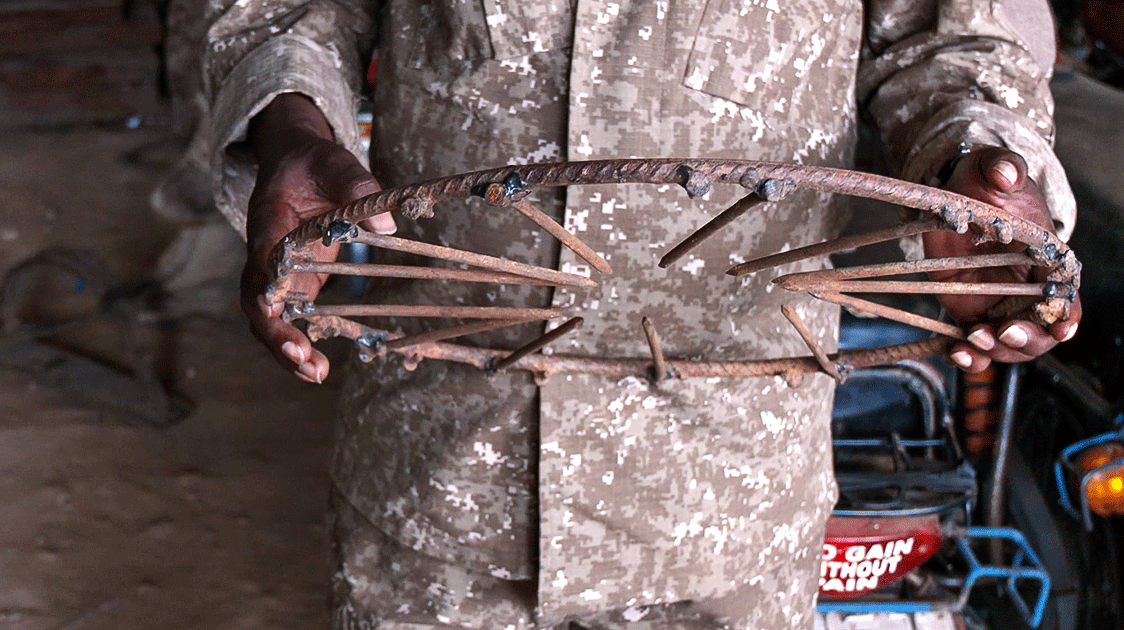
The weapons used for poaching include rifles, shotguns, gin traps, fish nets, assegais, and snares.
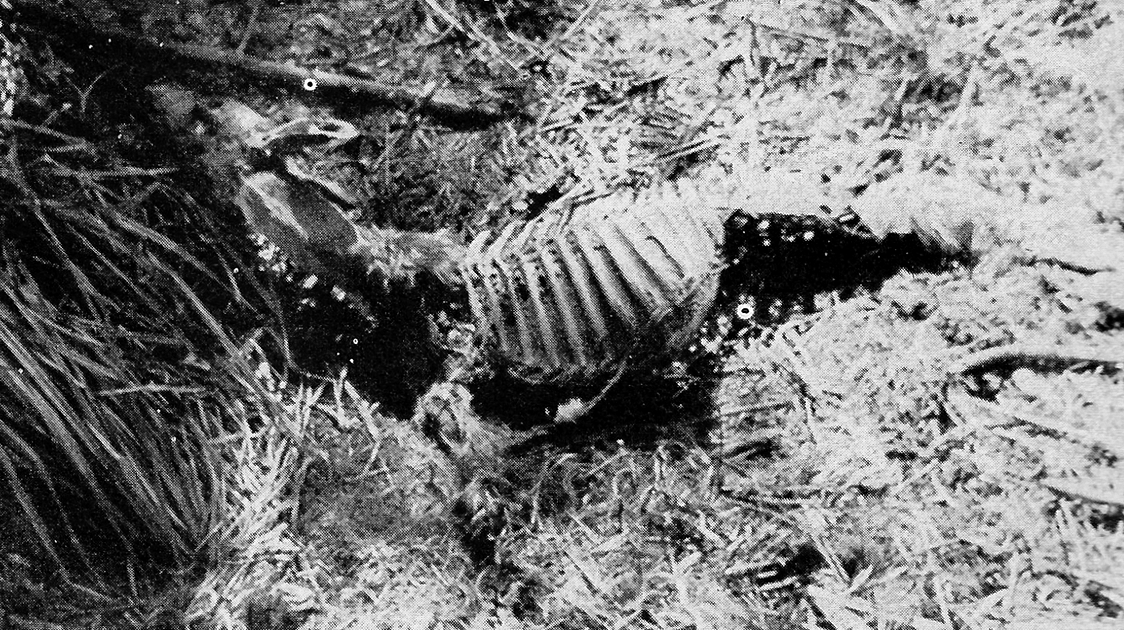
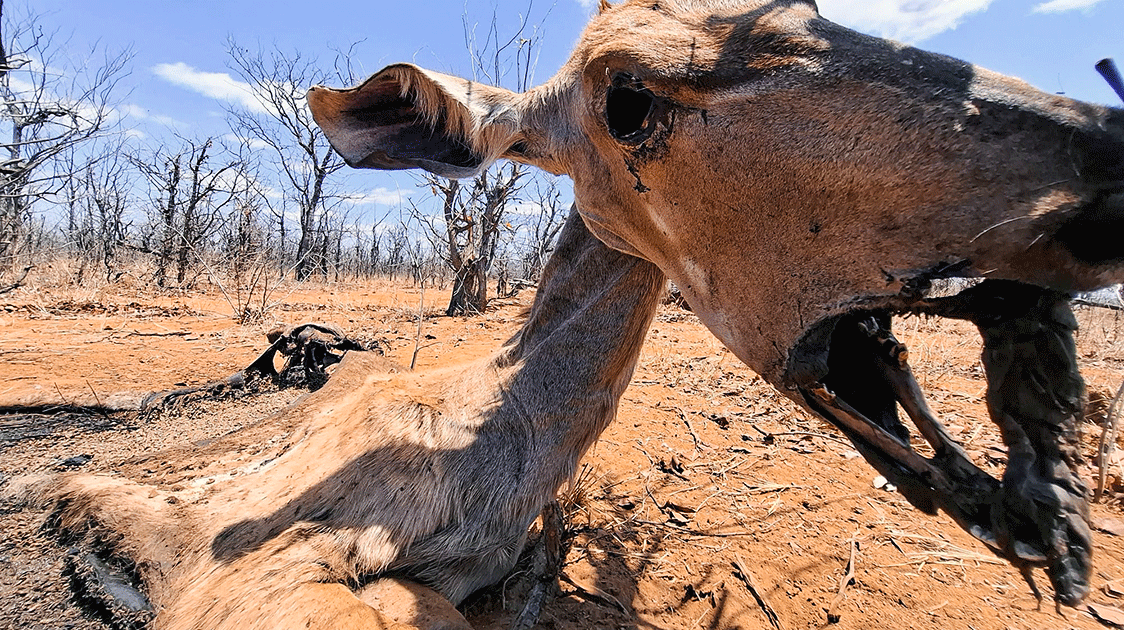
The photo shows a bushbuck doe found dead in a snare. On 24th June this year, Don Wedderburn arrested a poacher, complete with a quarry bag, snares, and a knife, in the process of slaughtering a duiker doe caught in one of his snares. A charge was laid, but some few weeks later, the police notified him that the case was closed!
By far the most serious poaching taking place outside the game reserves, on farmland and in forests in Natal, is snaring animals and birds with wire snares or nooses.
When I came back to Natal from Zululand in 1974, I was struck by two cardinal points:
- The monumental task of controlling the snaring of wildlife on Natal's vast farms.
- The almost total lack of an educational thrust to convince rural-dwelling workers that the snaring of game was a serious and cruel infringement of the province’s wildlife laws.
Where we can, we collect snares on farms, but the task is clearly beyond us as an organisation and is really the responsibility of the landowner. To this end, we have encouraged groups of landowners to pool their resources and employ game guards to patrol their farms.
It is not uncommon to remove 80-100 snares from one farm.
These snares, many of which are never revisited, remain lethal for years.
Now, there is nothing new about snaring as a means of hunting game, and it was even used in Biblical times.
Reference the words of Psalm 91:3 "He shall deliver thee from the snare of the fowler and from noisome pestilence."
As I have said, the NPB loses no opportunity to enforce the wildlife laws. Law enforcement as a means of wildlife conservation is surely important, but it cannot proceed in isolation.
It is too one-sided and, in the eyes of the black populace, particularly, conservation is, unfortunately, associated with the word "force". Most black people see conservation as a white man's game and game reserves as their playgrounds
Let us look at it from the average black farm worker or tribal man's point of view.
He lives and works on a farm where he has lived his whole life. For as long as he can remember, whites have been hunting on that farm. He takes part usually only as a beater or gun-bearer.
On any one day in season, he may see 40 or 50 hunters arrive on the farm for a hunt. At the end of the day, he helps to collect the bag. 30 or so waterfowl, some guineafowl, maybe a reedbuck or two.
Often, he notices that some protected or specially protected birds have also been "accidentally" shot. A few days later, some game guards arrive at the farm and check for snares; one or two workers are apprehended, and the remainder receive a lecture on obeying the law.
Whichever way the worker looks at conservation, he sees it as something for the privileged class.
He asks himself: Where can I go on a legal hunt?
The answer is usually nowhere.
How can he get some of that protein-rich meat?
Only by one means. Illegally!
Do you wonder then that he comes to regard conservation as something for the privileged class?
I find it very difficult to talk to people who are mainly spectators about the rules and benefits of a game they cannot play.
One might ask, where does the answer lie?
The answer lies in making these people a part of the game. I would like to illustrate this by a hunt I witnessed in the Highflats area of Natal 2 years ago.
The pre-hunt Xhosa ceremony performed by the huntsmen and dog handlers was very stirring.
About 12 of them approached the scene, singing and beating one stick against another. The song was a lamenting rhythm of particular appeal.
When they arrived amongst us, the hunt-master, David Camp, lay down on his side, drew his feet up and cradled his rifle between folded arms.
From behind the singing huntsmen emerged a young Xhosa with a small branch of green leaves held in both hands in front of his face. As the song rose in crescendo, he approached the figure on the ground and, with slow rhythmic movements, gently placed parts of the branch on the man's head and side.
Finally, they all crouched over the prostrate form and beat one stick heavily on the other, imitating body strikes. Thus, the impressive ceremony ended. This scene was a fine example of group involvement.
Nobody was left out.
The New Thrust for Conservation must be in the provision of AWARENESS and EDUCATION amongst the black populace in Natal.
Those of us charged with the future direction of conservation have a duty to ensure we alter course to include all people.
The biggest danger is not poaching.
The biggest danger is that the black youth, particularly, may reject conservation as a white-created, white-dominated, whites-only syndrome in which they have no part.
It could be disastrous.
I respect the educational work done by such organisations as SACCAP, the Wildlife Society, and the Wilderness Leadership School.
However, logistically and because time is against us, we just cannot get all the people we want to influence to the wilderness to convince them of the need for conservation.
We must bring the wilderness and conservation to the people.
In my travels through Natal, I often pass hundreds of Zulu schoolchildren running to school along the roads.
Sometimes I like to stop and talk to them. When they first eye my uniform and radio car, they appear afraid, even hostile. But when I talk to them in Zulu, and they realise I am interested in wild animals and birds, their faces light up, and they gesticulate and laugh.
It makes me realise that they are thirsting to be let in on this wonderful conservation secret, to be enfolded in the warm embrace of the wilderness.
You will perhaps understand me when I say that we in Natal should spend much more money on conservation education of the populace.
I believe the NPB, with its talented staff and financial resources, has the ability to launch such a campaign in Natal. We need your support.
Let's conserve our resources and energy for the monumental task of committing all the people of Natal to the Conservation Struggle.
We might just win.