The Cost of Free: Why Unpriced Nature Disappears

By Prof Brian Child
Key Takeaways:
- Because wildlife is unpriced or underpriced, the market systematically underproduces it.
- Subsidies for agriculture, combined with the absence of property rights for wild resources, tilt the playing field against wildlife and produce the wrong outcomes at massive scale.
- Sustainability is fundamentally an economic problem.
- Before markets can function, property rights and exclusion rights must exist. Getting prices right begins with getting institutions right.
- Zimbabwe and Namibia demonstrated that when wildlife officials corrected market failures and gave landholders and communities a genuine financial stake in wildlife, conservation followed the money, without relying on subsidies or sentiment.
Economic man and sustainability
Human success and prosperity are rooted in a 'cognitive revolution'. Biologically, we are economic man, with unique abilities to cooperate, specialize, exchange, and control these processes through institutions and technology (Bethell, 1998; Reader, 1999; Harari, 2014) - features that lie at the heart of the subject we call economics.
Despite our success as economic man, our governing myths and ideologies have excluded nature from the economy. Priceless nature is unpriced or underpriced, resulting, in the dry words of economists, in a serious problem of under-supply.
Our natural planet is in jeopardy.
We need to question the underlying assumptions and ideologies about how we govern nature, and to factor the sustainability and value of nature into the economic future of the planet.
A practical definition of the somewhat elusive concept of sustainability is provided by the ditty: 'more (well-being) from less (resources), for more (people), forever'.
Sustainability is deeply economic and includes three components. 'More from less' is about economic efficiency.
Essentially, this is about 'getting prices right' to allocate resources to the highest valued uses possible.
Social equity, the second issue, concerns who benefits from this efficiency and is a political question about environmental justice and who owns resources in the first place.
For many reasons, the people who live with wildlife should own it and get a fair price for their assets.
The third issue concerns ecosystem sustainability and maintaining the capital in our ecological bank account.
We might understand the wonder of these natural systems through the biological and ecological sciences, but establishing the incentives for maintaining these environmental stocks lies firmly in the realm of economics and governance.
This defines three circles of sustainability - economic viability, socio-political acceptability, and ecological sustainability (Child, 1995).
Wildlife conservation as an economic problem
The proposition that we can save nature by incorporating it into the economy is bold, controversial, and certainly not mainstream.
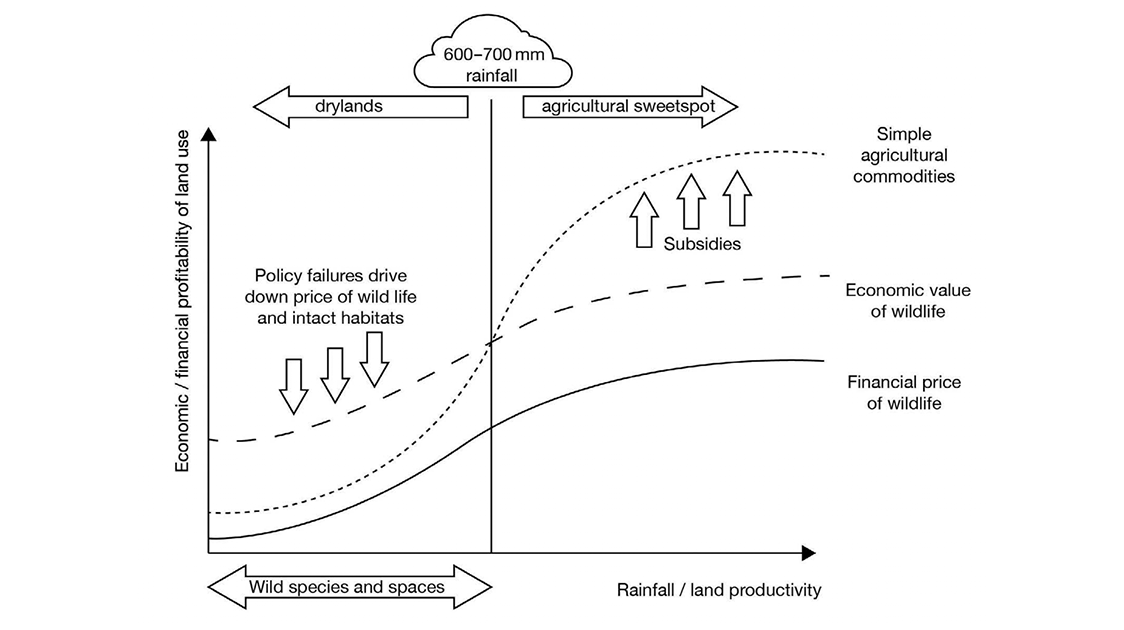
The starting point is the simple economic model (Figure 6.2) that underpins the sustainable use approach (SASUSG, 1996). In drylands, wildlife has an economic comparative advantage (the upper dashed curve in Figure 6.2), because the priced and unpriced values of wildlife exceed that of other land uses.
However, wildlife's economic comparative advantage (defined in box 6.1) is not reflected in financial prices (the lower dashed curve) because of market or policy failures.
Many conservationists rely on public funding or rich benefactors to subsidize it, but to get wildlife back, administrators in Southern Africa identified and addressed these market failures to enable wildlife to pay for itself.
Wildlife administrators, however, have less power to influence the profit curves of domestic species, which are overpriced (or subsidized) for several reasons. For some 5,000 years, simple cadastral tenure (Bowles & Choi, 2013) has allowed farmers to own, invest in, and benefit from domestic species, but not from wild species.
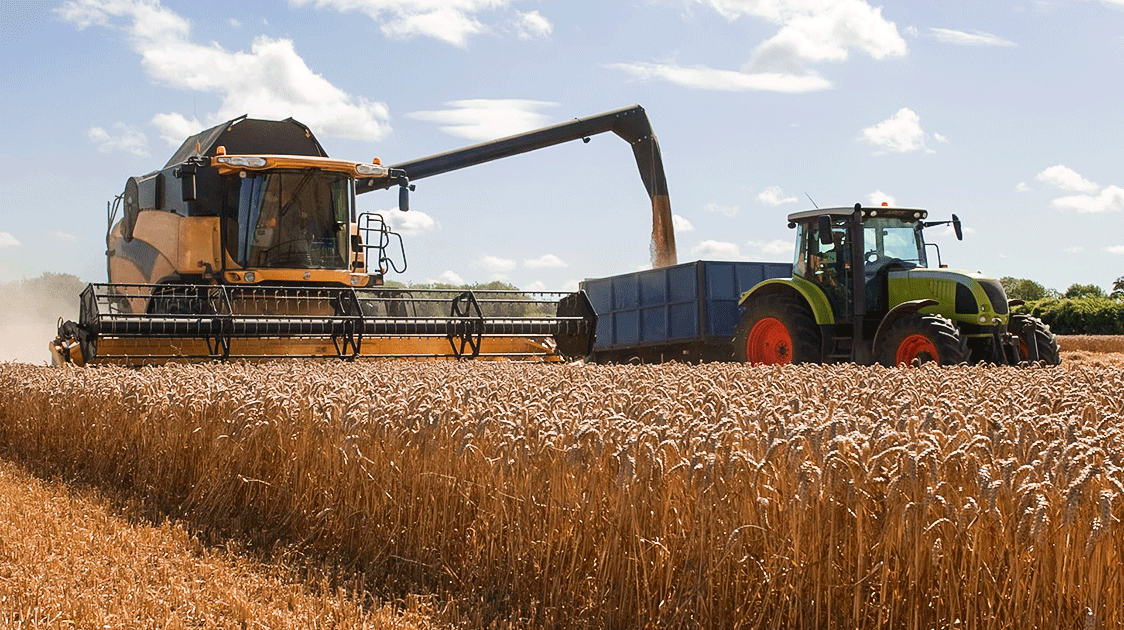
Moreover, farming is invariably subsidized, directly through price support, indirectly through research, agricultural services, and infrastructure, and by not paying the full environmental costs of production.
Together, these factors (i.e. differentially favorable institutions, subsidies, taxes, and regulations) have driven down the profit curve for wild species, driven up the profit curve for domestic species, and given us the wrong outcomes.
On a global scale, high-value wild resources are being replaced by low-value domestic crops and animals (Anon, 2011; Smil, 2011).
Wildlife recovered in southern Africa because wildlife officials, especially in Zimbabwe and Namibia, incorporated these profit curves as a cornerstone in policymaking.
Thus, to quote my father, the director of the wildlife agency in Zimbabwe:
Wildlife is a renewable resource, which, like other resources, must be conserved and used wisely. Its continued existence outside protected areas will depend on its competitive ability in terms of landholder benefits. (Child, 1995, p 70)
However, correcting the economic curves requires institutional reform, and we see the importance of the concepts of proprietorship and price emerging.
Thus:
Wildlife can compete with other land uses because it has an economic comparative advantage, but it will be conserved only if this advantage is reflected in market prices and landholders receive a sufficient share of the benefits. (Child, 1995, p 70)
Recognizing that prices coordinate the allocation of land and wildlife, wildlife administrators sought to 'get prices right' for wildlife through policy reforms that shifted the financial curve upward toward the economic curve.
Where prices were missing (as for wildlife), or subsidized (as for livestock), the pricing mechanism could not be trusted to allocate land to the best uses, or to maintain the capital stock of the environment.
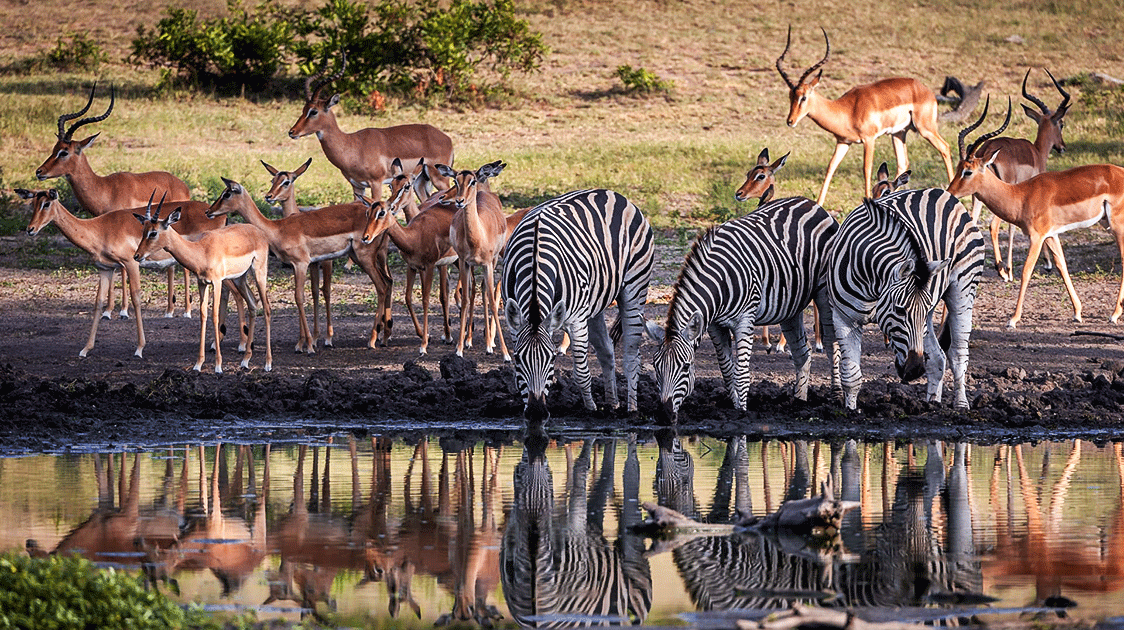
Wildlife officials inherited policies that did not dollarize wildlife. However, they learned that without a price, wildlife on productive land was replaced by commodities that do have a price.
The costs of wildlife, such as crop damage or livestock losses, were measured in dollars, but the benefits of wildlife were not measured in this way, so it was categorized as a nuisance.
Indeed, whole departments - the game departments of colonial Africa - were established to 'control' wildlife because of its negative value. Politically, too, wild land was perceived as 'under-utilized' and open to ever more agricultural commodity production because the value of natural systems were not dollarized.
To 'get prices right', wildlife administrators set out to maximize the value of wildlife but also to internalize the full costs of land use, including deforestation and soil erosion.
With Zimbabwean administrators being obsessed by healthy soils and soil erosion, conservation became a quest for wise and efficient land use and 'economic efficiency', rather than to promote any single land use (like wildlife). Instead of a singular focus on wildlife, officials began to prioritize the rights and well-being of landholders and communities.
Good farming practices were encouraged in the agricultural sweet spot because growing more food, better, would reduce the demand to farm drylands more suited to the wildlife economy.
Wise land use and economic efficiency are laudable goals, and the vehicle to get some institutions to internalize the costs and benefits of different land uses as completely as possible, together with the concept of comparative advantage (Box 6.1).
BOX 6.1 THE CONCEPT OF COMPARATIVE ADVANTAGE
Comparative advantage is a critical concept in economics. Its message is that we are better off if we specialize in producing the goods and services that we are best at (relatively speaking) and use the profits from these to buy the other goods and services that we need.
For example, if Bill Gates can type at 120 words a minute and his personal assistant types at 80 words a minute, it still pays Bill Gates to delegate the typing.
He has an absolute advantage in typing, but he has an even greater gift for software development.
Most people will agree with this, yet they take the opposing viewpoint when you suggest that people in drylands should achieve food self-sufficiency by producing wildlife and buying food.
Wildlife has a comparative advantage in some drylands, including southern Africa, and earns as much as two to four times that of conventional beef production (Child et al.,2012).
Like Bill Gates, the sensible economic choice is for farmers and communities to produce wildlife and sell it to buy food.
Counterintuitively, producing wildlife reduces their vulnerability to hunger, whereas expecting them to grow their own food in areas where the climate is unreliable increases food vulnerability.
Resource allocation
The central challenge of economics is how to best allocate scarce resources (Pearce & Turner, 1990), with a debate over whether to achieve this through central planning or a decentralized marketplace.
Centralized planning seems orderly and assumes that politicians, bureaucrats, or technical experts are best placed to make choices about how resources are allocated.
The former USSR epitomized central economic planning, as do the public management and regulatory approaches that are a strong feature of natural resource management.
In the free-market system, by comparison, the allocation of resources is guided by prices and exchange between many thousands of individuals making their own choices.
The question is whether we have placed too much confidence in central planning and the public management of biodiversity. Have we got the balance wrong, and should we strengthen tenure, pricing, and market mechanisms to improve the allocation and sustainability of wild resources outside protected areas?
Prices
Economists would call this 'getting prices right'. But what are prices, how are they formed, how do they work, and why should we trust them to allocate precious wild resources?

Introductory economics courses explain that prices provide the signals that guide resource allocation, and that prices emerge through the interaction of supply and demand, or what is called equilibrium theory.
However, less recognized is the reality that prices cannot form in the absence of ownership and exchange. This gives us two theories of price. We will introduce equilibrium theory quickly, but belabor what I have clumsily called the "property theory of price' because this is crucial for developing countries and natural resources.
Internalizing costs and benefits: the Coase theorem
Central to economic thinking is the concept that if the costs and benefits of an action are fully internalized, individuals will make the right decision for society after weighing these up.
Ronald Coase (1960) made exactly this point in "The Problem of Social Cost', cited by the Nobel committee in 1991. Coase set up the problem of a cattle rancher living next to a farmer, where cattle ate the crops unless constrained.
With elegant reasoning, he showed how the two parties negotiated an optimal solution depending on the price of crops, cattle, or fencing, provided that property rights were clearly delineated (and in the absence of transaction costs).
The nub of Coase's argument is that people bargain their way to the most efficient use of resources, provided costs and benefits are fully internalized. Thus, clearly defined property rights are a necessary condition for establishing prices and for efficient resource trade-offs.
This compelling argument underpins the free market economy, but these conditions are strikingly absent in ungoverned spaces.
Property rights and exclusion as a basis for price
Conventional economic theory assumes that property rights are widespread, well-defined, and operational. However, this is not the case for wild resources and ungoverned spaces, and, surprisingly, the importance of property rights and exchange is so widely ignored in economic debates about wild resources.
In a discussion with the distinguished economist, Mancur Olson, Tom Bethell writes:
Starting with Adam Smith, all the leading economists came from just those countries where the essential legal preconditions for real economic advance did exist. So, they took them for granted.
This was a 'tremendous oversight,' Olson admitted. 'Economics developed, loosely speaking, in a particular type of society, namely democratic societies with secure rights and independent judiciaries, so people haven't bothered to think about these things very much in economics' (Bethell, 1998)
The 'property theory of price' that I will now describe is more foundational than the theories of supply and demand and general equilibrium. It is not new, just so obvious that it is often forgotten.
The property theory of price is illustrated by a simple example. If you live in a society without property rights, I can simply take your pen when I want it - it has no price, except the cost of brute force.
This was the nasty, brutish condition of mankind as described by Thomas Hobbes before rights of property and exclusion were entrenched and protected.
By contrast, in a society which gives you clear rights to your pen and protects them, I cannot take your pen by force because it is, indeed, your pen. If I want it, I will need to negotiate with you for it.
Being stronger or having more weapons or personal connections than you have does not allow me to take it. Through this negotiation, the pen gets a price, which regulates the production and consumption of pens.
We create wealth by exchanging things with each other, and we do so peacefully.
This theory of price rests on the following sequence: ownership, exclusion, negotiation, and price. You own your pen. This gives you the right to exclude me from simply taking the pen.
Therefore, if I want it, I have to negotiate a trade. This negotiation sets the price of pens, and the price of pens guides the economy to produce exactly the right number of pens.
Economists call this 'getting prices right.'
However, to get prices right, we also need to design and protect the institutions governing property rights and exchange (North, 2003). Protecting order and the rights of persons and property is the foundational purpose of the modern liberal state.
In these circumstances, so familiar to the citizens of liberal democracies that they are almost forgotten, goods change hands peacefully through mutual agreement and negotiation- the free market.
We forget to our peril that many people, especially in forests and drylands, are not living in such circumstances. Without rights and low-cost, peaceful exclusion, they live in a world far more akin to Hobbes's description.
Economic systems as we know them are dysfunctional, including for wild resources.
Resources are used wastefully and inefficiently, in circumstances leaving local communities subject to violence and criminality, land and resource grabbing, and landlessness (Murombedzi,2014).
In the absence of both proprietorship and exchange, nature is locked in a low-value grab-all economy. By now, it should be obvious that the wildlife economy cannot function in the absence of property rights and low-cost exclusion.
What is less obvious is that it also cannot operate in the absence of exchange and trade.
Prof Brian Child is an associate professor in the Department of Geography and Center for African Studies at the University of Florida and the Life Through Wildlife Project director. His book, “Sustainable Governance of Wildlife and Community-Based Natural Resource Management”, is available on Amazon.